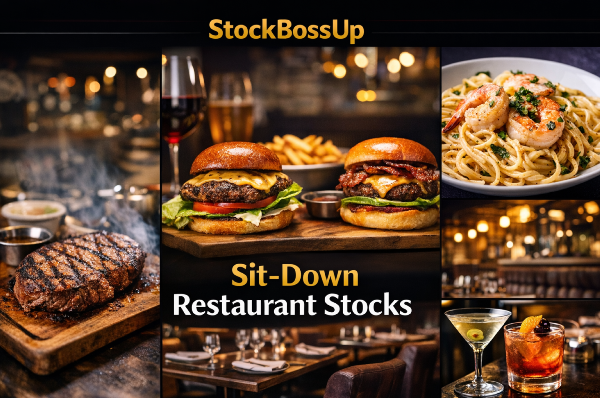
Sit‑down restaurant stocks give investors a window into a part of the food industry that depends on service, atmosphere, and customer loyalty. These companies operate full‑service restaurants where guests are seated, served by staff, and often stay longer than they would at fast‑food chains. Because of this, the business model is different from quick‑service restaurants. Revenue per guest is usually higher, but costs are higher too. Investors who want a broader view of the food sector often compare this group with the companies covered in the Best Fast Food Stocks to Buy Now guide.
Every Sit-Down Restaurant you can Invest in
NYSE Sit‑Down Restaurant Stocks
| Company |
Ticker |
Market‑Cap Tier |
Dividend Yield |
Notes |
| Dine Brands Global |
DIN |
Small‑cap |
~4.0% |
Applebee’s, IHOP |
| Brinker International |
EAT |
Mid‑cap |
~3.0% |
Chili’s, Maggiano’s |
| Darden Restaurants |
DRI |
Large‑cap |
~3.3% |
Olive Garden, LongHorn |
NASDAQ Sit‑Down Restaurant Stocks
| Company |
Ticker |
Market‑Cap Tier |
Dividend Yield |
Notes |
| Bloomin’ Brands |
BLMN |
Mid‑cap |
~3.0% |
Outback, Carrabba’s |
| Texas Roadhouse |
TXRH |
Large‑cap |
~1.7% |
Full‑service steakhouse |
| Cracker Barrel |
CBRL |
Small‑cap |
~8.0% |
Sit‑down + retail |
| First Watch Restaurant Group |
FWRG |
Mid‑cap |
0% |
Daytime brunch |
| BJ’s Restaurants |
BJRI |
Small‑cap |
0% |
Brewhouse |
| Kura Sushi USA |
KRUS |
Small‑cap |
0% |
Conveyor‑belt sushi |
| The ONE Group Hospitality |
STKS |
Small‑cap |
0% |
STK Steakhouse |
OTC Sit‑Down Restaurant Stocks (U.S.-Tradeable)
| Company |
Ticker |
Market‑Cap Tier |
Dividend Yield |
Notes |
| Ark Restaurants |
ARKR |
Micro‑cap |
~4.5% |
Full‑service restaurants in NY, FL, NV |
| Good Times Restaurants |
GTIM |
Micro‑cap |
0% |
Bad Daddy’s Burger Bar (sit‑down) |
Introduction to Sit Down Restaurant Stocks
Sit‑down restaurants can grow when people feel confident about their finances. They can also struggle when budgets tighten. This makes the sector a useful signal for understanding how consumers feel about the economy. For a wider look at how restaurants fit into the market, the article on How the Restaurant Industry Fits into the Consumer Cyclical Sector provides helpful context.
Many of the largest sit‑down restaurant companies in the United States trade on the NYSE or NASDAQ. These include well‑known brands like Olive Garden, Outback Steakhouse, and Texas Roadhouse. Each company has its own strategy, menu style, and customer base. Some focus on value. Others focus on premium dining. Some rely on franchising, while others own most of their locations.
One detail that surprises many new investors is that sit‑down restaurants often perform better during weekday lunch hours in suburban areas than in major cities. This is because suburban families tend to dine out more often during the week. Another lesser‑known detail is that some restaurant chains earn more profit from alcohol sales than from food, even though alcohol makes up a smaller share of total orders.
Before diving into individual companies, it helps to understand the main forces that shape the industry. Labor costs, food inflation, supply chain issues, and real estate all play major roles. A small change in any of these areas can affect margins. For a deeper look at how rising costs affect the sector, see the analysis in How Inflation and Food Costs Impact Restaurant Stocks.
What Makes Sit‑Down Restaurant Stocks Different
Sit‑down restaurants rely heavily on the guest experience. This includes service quality, menu design, wait times, and the overall feel of the dining room. Because of this, these companies invest more in training, staffing, and real estate than fast‑food chains. They also tend to have larger kitchens and dining rooms. Investors who want to compare these models can explore the Top Casual Dining Stocks for Long Term Investors article.
Another difference is how revenue is generated. Sit‑down restaurants often earn more per customer because meals are larger and include add‑ons like appetizers, desserts, and drinks. Alcohol sales are especially important. Many chains report that alcohol has higher margins than food, which helps support profits even when food costs rise.
The business model also depends on table turnover. A restaurant that fills its tables quickly and keeps them full during peak hours can earn much more than one with slow turnover. This is why many chains focus on improving waitlist systems, online reservations, and kitchen speed.
During economic downturns, sit‑down restaurants can face pressure. Customers may choose cheaper options or cook at home. But strong brands with loyal customers often recover quickly. Investors who understand these cycles can find opportunities when stock prices fall. For a deeper look at how restaurants behave in tough markets, see the guide on Best Restaurant Stocks During Recession.
Industry Trends Shaping the Future
Several trends are shaping the future of sit‑down restaurant stocks. One major trend is the rise of digital ordering. Even though these restaurants focus on dine‑in service, many now offer online ordering, curbside pickup, and delivery. This helps them reach customers who want convenience without giving up their favorite meals.
Another trend is menu simplification. Many chains have reduced the number of items they offer. This helps lower food waste, speed up kitchen operations, and improve consistency. It also helps restaurants manage inflation when ingredient prices rise.
Health and wellness trends are also influencing menus. Customers want fresher ingredients, more vegetables, and fewer processed foods. Some chains have added plant‑based options or lighter meals to meet this demand.
Real estate strategy is another key trend. Some companies are opening smaller locations with fewer seats. Others are expanding into new regions where competition is lower. Suburban growth has been strong, especially in areas with rising populations. For a broader view of where the industry is heading, the Restaurant Industry Outlook (2025–2026) article offers helpful forecasts.
Financial Metrics Investors Should Watch
Investors who follow sit‑down restaurant stocks often track several key metrics. These include same‑store sales, which measure how existing restaurants perform compared to the previous year. This metric shows whether a brand is growing or losing momentum.
Another important metric is restaurant‑level margin. This measures how much profit a restaurant makes after food, labor, and operating costs. When food inflation rises, margins can shrink unless companies raise menu prices or improve efficiency.
Traffic trends are also important. A restaurant can increase sales by raising prices, but long‑term growth depends on bringing in more customers. Investors watch traffic closely to see whether a brand is staying relevant.
Debt levels matter too. Some restaurant companies carry large amounts of debt, especially if they own many of their locations. Others use franchising to reduce debt and shift costs to franchisees. For investors who want to explore franchising models, the article on Top Restaurant Franchising Stocks and Why Investors Love Them is a strong companion piece.
Financial Snapshot of Key Sit‑Down Chains
| Company |
Same‑Store Sales Trend |
Restaurant‑Level Margin |
Notes |
| DRI |
Stable |
Strong |
Large portfolio helps balance risk |
| EAT |
Mixed |
Moderate |
Chili’s promotions drive traffic |
| DIN |
Improving |
Moderate |
Heavy focus on franchising |
| TXRH |
Strong |
Strong |
High guest loyalty |
| CBRL |
Mixed |
Moderate |
Retail stores add revenue |
Deep Dive: Major Sit‑Down Restaurant Stocks
Darden Restaurants
Darden Restaurants operates some of the most recognized sit‑down brands in the country. Olive Garden and LongHorn Steakhouse are the company’s largest chains. Olive Garden is known for pasta and family‑style meals. LongHorn focuses on steak and casual dining. Darden’s size gives it strong buying power, which helps control food costs.
Brinker International
Brinker International owns Chili’s and Maggiano’s. Chili’s is the larger brand and focuses on value‑driven meals like burgers, fajitas, and ribs. The company often uses promotions to bring in customers. These promotions can boost traffic but may reduce margins if not managed carefully.
Dine Brands Global
Dine Brands operates Applebee’s and IHOP. Both brands rely heavily on franchising. This means franchisees own and operate most locations. The company earns revenue from fees and royalties rather than running the restaurants directly.
Brand Positioning Overview
| Company |
Value Focus |
Premium Focus |
Franchising |
Owned Locations |
| DRI |
Moderate |
Moderate |
Low |
High |
| EAT |
High |
Low |
Low |
High |
| DIN |
High |
Low |
High |
Low |
| BLMN |
Moderate |
Moderate |
Low |
High |
| TXRH |
Moderate |
Low |
Low |
High |
Growth Stocks in the Sit‑Down Restaurant Sector
Some sit‑down restaurant stocks focus on growth rather than stability. These companies often open new locations, expand into new regions, or introduce new concepts. Growth stocks can be more volatile, but they may offer higher long‑term returns. For investors who want to compare growth across the industry, the article on Restaurant Stocks with the Fastest Revenue Growth is a useful resource.
First Watch
First Watch is a daytime dining chain that focuses on breakfast, brunch, and lunch. It has grown quickly by offering fresh ingredients and a modern menu. The company owns most of its locations, which gives it more control over quality.
Kura Sushi USA
Kura Sushi operates conveyor‑belt sushi restaurants. This model is popular with younger customers and families. The company uses automation to reduce labor costs. This helps support margins even when wages rise.
The ONE Group
The ONE Group operates STK Steakhouse and Kona Grill. STK is a modern steakhouse that blends dining with nightlife. Kona Grill offers sushi and American meals in a casual setting.
How Economic Cycles Affect Sit‑Down Restaurant Stocks
Sit‑down restaurants are sensitive to economic cycles. When the economy is strong, customers dine out more often. They also spend more per visit. This helps support revenue and profit growth. When the economy slows, customers may cut back on dining out. They may choose cheaper meals or skip appetizers and drinks.
Inflation can also affect the sector. When food prices rise, restaurants must decide whether to raise menu prices. Raising prices too quickly can reduce traffic. Not raising prices can reduce margins. For investors looking for protection during inflation, the guide on Best Restaurant Stocks for Inflation is a helpful companion.
Labor costs are another factor. Sit‑down restaurants rely on servers, cooks, hosts, and managers. When wages rise, costs rise. Some companies use technology to improve efficiency. Others adjust staffing levels or simplify menus.
Economic Sensitivity Comparison
| Company |
Sensitivity to Inflation |
Sensitivity to Labor Costs |
Customer Loyalty |
| TXRH |
Moderate |
High |
High |
| DRI |
Moderate |
Moderate |
High |
| CBRL |
High |
High |
Moderate |
| BJRI |
High |
High |
Moderate |
| FWRG |
Moderate |
Moderate |
Growing |
Long‑Term Outlook for Sit‑Down Restaurant Stocks
The long‑term outlook for sit‑down restaurant stocks depends on several factors. Population growth, suburban expansion, and rising incomes can support demand. Technology will continue to shape how customers order and interact with restaurants. Companies that adapt quickly may gain an advantage.
Brand strength will remain important. Customers return to restaurants they trust. Chains that maintain quality and service are more likely to grow. Companies that invest in training, menu innovation, and customer experience may outperform over time.
Real estate strategy will also matter. Restaurants that choose strong locations with steady traffic can perform well even during slow periods. Companies that expand too quickly or choose weak locations may face challenges. For investors who want to explore global opportunities, the article on Best International Restaurant Stocks for Global Exposure is a strong next step.
Investors who want exposure to consumer spending often include sit‑down restaurant stocks in their portfolios. These stocks can offer a mix of stability, growth, and dividends. They also provide insight into how consumers feel about the economy. For dividend‑focused investors, the guide on Restaurant Stocks with Strong Dividend History is worth exploring.
Final Thoughts
Sit‑down restaurant stocks offer a unique way to invest in the dining industry. They combine service, atmosphere, and menu quality in a way that fast‑food chains do not. The sector includes stable giants, value‑focused brands, and fast‑growing newcomers. Each company has its own strengths and risks.
Investors who understand the industry’s trends, financial metrics, and economic cycles can make informed decisions. Whether you prefer stable dividend payers or high‑growth concepts, the sit‑down restaurant sector has options for many types of investors. For more niche categories, you can explore focused guides like The Top Pizza Stocks or The Top Taco Stocks.
🔥 Read More: Explore Restaurant Stock Battles



Sit‑down restaurant stocks give investors a window into a part of the food industry that depends on service, atmosphere, and customer loyalty. These companies operate full‑service restaurants where guests are seated, served by staff, and often stay longer than they would at fast‑food chains. Because of this, the business model is different from quick‑service restaurants. Revenue per guest is usually higher, but costs are higher too. Investors who want a broader view of the food sector often compare this group with the companies covered in the Best Fast Food Stocks to Buy Now guide.
Every Sit-Down Restaurant you can Invest in
NYSE Sit‑Down Restaurant Stocks
NASDAQ Sit‑Down Restaurant Stocks
OTC Sit‑Down Restaurant Stocks (U.S.-Tradeable)
Introduction to Sit Down Restaurant Stocks
Sit‑down restaurants can grow when people feel confident about their finances. They can also struggle when budgets tighten. This makes the sector a useful signal for understanding how consumers feel about the economy. For a wider look at how restaurants fit into the market, the article on How the Restaurant Industry Fits into the Consumer Cyclical Sector provides helpful context.
Many of the largest sit‑down restaurant companies in the United States trade on the NYSE or NASDAQ. These include well‑known brands like Olive Garden, Outback Steakhouse, and Texas Roadhouse. Each company has its own strategy, menu style, and customer base. Some focus on value. Others focus on premium dining. Some rely on franchising, while others own most of their locations.
One detail that surprises many new investors is that sit‑down restaurants often perform better during weekday lunch hours in suburban areas than in major cities. This is because suburban families tend to dine out more often during the week. Another lesser‑known detail is that some restaurant chains earn more profit from alcohol sales than from food, even though alcohol makes up a smaller share of total orders.
Before diving into individual companies, it helps to understand the main forces that shape the industry. Labor costs, food inflation, supply chain issues, and real estate all play major roles. A small change in any of these areas can affect margins. For a deeper look at how rising costs affect the sector, see the analysis in How Inflation and Food Costs Impact Restaurant Stocks.
What Makes Sit‑Down Restaurant Stocks Different
Sit‑down restaurants rely heavily on the guest experience. This includes service quality, menu design, wait times, and the overall feel of the dining room. Because of this, these companies invest more in training, staffing, and real estate than fast‑food chains. They also tend to have larger kitchens and dining rooms. Investors who want to compare these models can explore the Top Casual Dining Stocks for Long Term Investors article.
Another difference is how revenue is generated. Sit‑down restaurants often earn more per customer because meals are larger and include add‑ons like appetizers, desserts, and drinks. Alcohol sales are especially important. Many chains report that alcohol has higher margins than food, which helps support profits even when food costs rise.
The business model also depends on table turnover. A restaurant that fills its tables quickly and keeps them full during peak hours can earn much more than one with slow turnover. This is why many chains focus on improving waitlist systems, online reservations, and kitchen speed.
During economic downturns, sit‑down restaurants can face pressure. Customers may choose cheaper options or cook at home. But strong brands with loyal customers often recover quickly. Investors who understand these cycles can find opportunities when stock prices fall. For a deeper look at how restaurants behave in tough markets, see the guide on Best Restaurant Stocks During Recession.
Industry Trends Shaping the Future
Several trends are shaping the future of sit‑down restaurant stocks. One major trend is the rise of digital ordering. Even though these restaurants focus on dine‑in service, many now offer online ordering, curbside pickup, and delivery. This helps them reach customers who want convenience without giving up their favorite meals.
Another trend is menu simplification. Many chains have reduced the number of items they offer. This helps lower food waste, speed up kitchen operations, and improve consistency. It also helps restaurants manage inflation when ingredient prices rise.
Health and wellness trends are also influencing menus. Customers want fresher ingredients, more vegetables, and fewer processed foods. Some chains have added plant‑based options or lighter meals to meet this demand.
Real estate strategy is another key trend. Some companies are opening smaller locations with fewer seats. Others are expanding into new regions where competition is lower. Suburban growth has been strong, especially in areas with rising populations. For a broader view of where the industry is heading, the Restaurant Industry Outlook (2025–2026) article offers helpful forecasts.
Financial Metrics Investors Should Watch
Investors who follow sit‑down restaurant stocks often track several key metrics. These include same‑store sales, which measure how existing restaurants perform compared to the previous year. This metric shows whether a brand is growing or losing momentum.
Another important metric is restaurant‑level margin. This measures how much profit a restaurant makes after food, labor, and operating costs. When food inflation rises, margins can shrink unless companies raise menu prices or improve efficiency.
Traffic trends are also important. A restaurant can increase sales by raising prices, but long‑term growth depends on bringing in more customers. Investors watch traffic closely to see whether a brand is staying relevant.
Debt levels matter too. Some restaurant companies carry large amounts of debt, especially if they own many of their locations. Others use franchising to reduce debt and shift costs to franchisees. For investors who want to explore franchising models, the article on Top Restaurant Franchising Stocks and Why Investors Love Them is a strong companion piece.
Financial Snapshot of Key Sit‑Down Chains
Deep Dive: Major Sit‑Down Restaurant Stocks
Darden Restaurants
Darden Restaurants operates some of the most recognized sit‑down brands in the country. Olive Garden and LongHorn Steakhouse are the company’s largest chains. Olive Garden is known for pasta and family‑style meals. LongHorn focuses on steak and casual dining. Darden’s size gives it strong buying power, which helps control food costs.
Brinker International
Brinker International owns Chili’s and Maggiano’s. Chili’s is the larger brand and focuses on value‑driven meals like burgers, fajitas, and ribs. The company often uses promotions to bring in customers. These promotions can boost traffic but may reduce margins if not managed carefully.
Dine Brands Global
Dine Brands operates Applebee’s and IHOP. Both brands rely heavily on franchising. This means franchisees own and operate most locations. The company earns revenue from fees and royalties rather than running the restaurants directly.
Brand Positioning Overview
Growth Stocks in the Sit‑Down Restaurant Sector
Some sit‑down restaurant stocks focus on growth rather than stability. These companies often open new locations, expand into new regions, or introduce new concepts. Growth stocks can be more volatile, but they may offer higher long‑term returns. For investors who want to compare growth across the industry, the article on Restaurant Stocks with the Fastest Revenue Growth is a useful resource.
First Watch
First Watch is a daytime dining chain that focuses on breakfast, brunch, and lunch. It has grown quickly by offering fresh ingredients and a modern menu. The company owns most of its locations, which gives it more control over quality.
Kura Sushi USA
Kura Sushi operates conveyor‑belt sushi restaurants. This model is popular with younger customers and families. The company uses automation to reduce labor costs. This helps support margins even when wages rise.
The ONE Group
The ONE Group operates STK Steakhouse and Kona Grill. STK is a modern steakhouse that blends dining with nightlife. Kona Grill offers sushi and American meals in a casual setting.
How Economic Cycles Affect Sit‑Down Restaurant Stocks
Sit‑down restaurants are sensitive to economic cycles. When the economy is strong, customers dine out more often. They also spend more per visit. This helps support revenue and profit growth. When the economy slows, customers may cut back on dining out. They may choose cheaper meals or skip appetizers and drinks.
Inflation can also affect the sector. When food prices rise, restaurants must decide whether to raise menu prices. Raising prices too quickly can reduce traffic. Not raising prices can reduce margins. For investors looking for protection during inflation, the guide on Best Restaurant Stocks for Inflation is a helpful companion.
Labor costs are another factor. Sit‑down restaurants rely on servers, cooks, hosts, and managers. When wages rise, costs rise. Some companies use technology to improve efficiency. Others adjust staffing levels or simplify menus.
Economic Sensitivity Comparison
Long‑Term Outlook for Sit‑Down Restaurant Stocks
The long‑term outlook for sit‑down restaurant stocks depends on several factors. Population growth, suburban expansion, and rising incomes can support demand. Technology will continue to shape how customers order and interact with restaurants. Companies that adapt quickly may gain an advantage.
Brand strength will remain important. Customers return to restaurants they trust. Chains that maintain quality and service are more likely to grow. Companies that invest in training, menu innovation, and customer experience may outperform over time.
Real estate strategy will also matter. Restaurants that choose strong locations with steady traffic can perform well even during slow periods. Companies that expand too quickly or choose weak locations may face challenges. For investors who want to explore global opportunities, the article on Best International Restaurant Stocks for Global Exposure is a strong next step.
Investors who want exposure to consumer spending often include sit‑down restaurant stocks in their portfolios. These stocks can offer a mix of stability, growth, and dividends. They also provide insight into how consumers feel about the economy. For dividend‑focused investors, the guide on Restaurant Stocks with Strong Dividend History is worth exploring.
Final Thoughts
Sit‑down restaurant stocks offer a unique way to invest in the dining industry. They combine service, atmosphere, and menu quality in a way that fast‑food chains do not. The sector includes stable giants, value‑focused brands, and fast‑growing newcomers. Each company has its own strengths and risks.
Investors who understand the industry’s trends, financial metrics, and economic cycles can make informed decisions. Whether you prefer stable dividend payers or high‑growth concepts, the sit‑down restaurant sector has options for many types of investors. For more niche categories, you can explore focused guides like The Top Pizza Stocks or The Top Taco Stocks.
🔥 Read More: Explore Restaurant Stock Battles