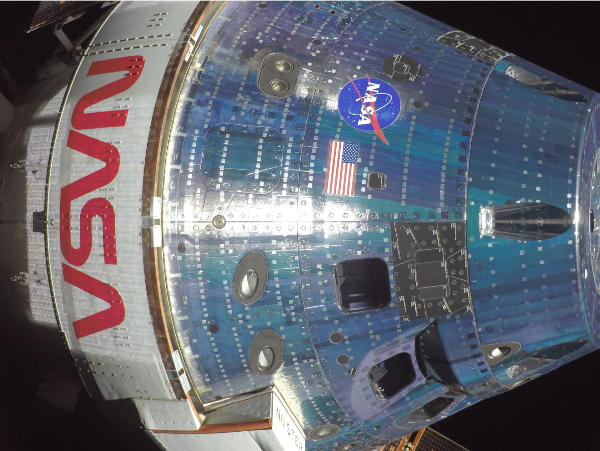
Cover Image Source: NASA.gov
How the Artemis Missions Could Reshape 20 U.S. Stocks — And Why Most Investors Miss the Real Impact
The Artemis program is one of the most ambitious space efforts in modern history. It aims to return humans to the Moon, build a long‑term lunar base, and prepare for future missions to Mars. Many investors know this already. What most people don’t realize is that a hidden problem sits underneath the excitement. The companies tied to Artemis do not all benefit in the same way. Some gain steady long‑term revenue. Others face unpredictable cycles. A few may even be at risk if the mission timeline shifts.
This article explores 20 U.S. publicly traded companies connected to Artemis. Each one plays a different role in the mission. But the real answer to the problem raised above will not appear until the end.
Why Do So Many Investors Misjudge Space‑Related Stocks?
Most people assume space stocks rise and fall with launch dates. That is only partly true. Artemis affects companies through supply chains, engineering contracts, materials, and mission support. These forces move at different speeds. Some respond to government budgets. Others depend on hardware cycles that last years.
Understanding these differences helps investors avoid simple assumptions.
The first group of companies includes major aerospace contractors. They build spacecraft, rockets, and propulsion systems. Their work is essential to Artemis, and their revenue often stretches across decades.
The second group includes engineering firms, technology suppliers, and component makers. They may not appear in headlines, but they provide the parts that make deep‑space travel possible.
The third group includes companies that support ground systems, imaging, and mission operations. Their work is less visible but still critical.
Before diving deeper, here is a quick look at the first set of companies and their roles.
Aerospace and Spacecraft Leaders
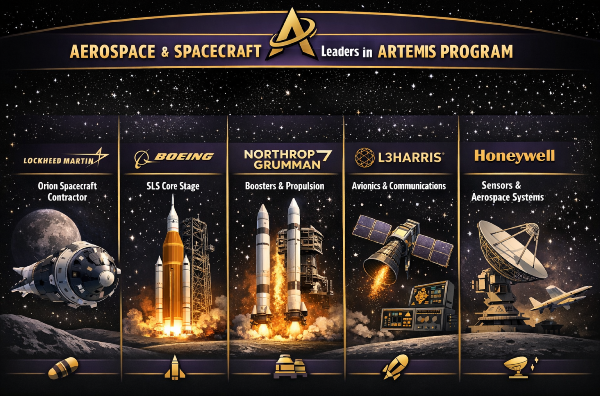
These companies build the core systems that make Artemis possible. Their work includes spacecraft design, rocket development, and propulsion.
| Company |
Primary Role in Artemis |
| Lockheed Martin (LMT) |
Orion spacecraft contractor |
| Boeing (BA) |
Space Launch System core stage |
| Northrop Grumman (NOC) |
Boosters and propulsion systems |
| L3Harris Technologies (LHX) |
Avionics and communication systems |
| Honeywell International (HON) |
Sensors, controls, and aerospace systems |
These companies form the backbone of the mission. Their work is long‑term and tied to multiple Artemis phases.
What Makes Hardware‑Cycle Stocks So Hard to Predict?
Hardware cycles in space programs do not follow normal business patterns. A company may spend years developing a system before it ever launches. Revenue can appear in waves. This makes forecasting difficult for investors who expect steady growth.
Lockheed Martin, for example, builds the Orion spacecraft. Each new mission requires updates, testing, and new components. The work is steady, but the timing varies.
Boeing faces similar challenges with the Space Launch System. The rocket is powerful, but delays can shift revenue from one year to another.
Northrop Grumman builds boosters that must withstand extreme forces. These systems require long testing periods. Investors who expect quick results may be disappointed.
This is why understanding the rhythm of hardware cycles is essential.
Another layer of complexity comes from the suppliers who support these companies.
Component and Technology Providers
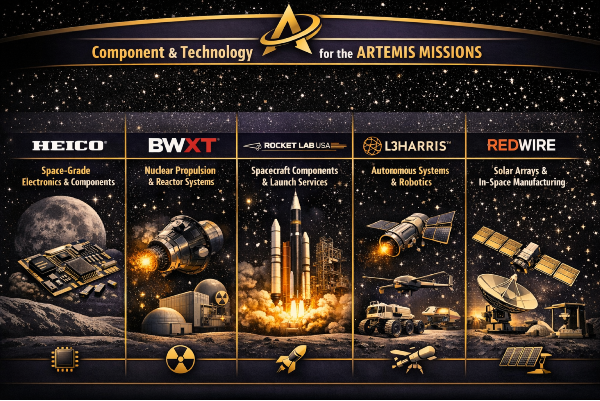
These companies supply electronics, materials, and specialized systems used in Artemis hardware.
| Company |
Contribution |
| HEICO (HEI) |
Space‑grade electronics and components |
| BWX Technologies (BWXT) |
Nuclear propulsion and reactor systems |
| Rocket Lab USA (RKLB) |
Spacecraft components and launch services |
| AeroVironment (AVAV) |
Autonomous systems and robotics |
| Redwire Corporation (RDW) |
Solar arrays and in‑space manufacturing |
One unique fact about space hardware is that some components must survive temperatures colder than liquid nitrogen, even before reaching space. This requirement shapes how companies like HEICO and Redwire design their systems.
These suppliers often benefit from multiple missions, not just Artemis. Their technology can be used in satellites, defense systems, and commercial spacecraft.
Why Do Ground‑Support Companies Matter More Than Most People Think?
Many investors overlook the companies that support Artemis from the ground. These firms manage launch infrastructure, mission operations, and engineering services. Without them, the spacecraft would never leave Earth.
Jacobs Solutions plays a major role at Kennedy Space Center. It supports testing, launch prep, and ground systems.
KBR provides astronaut training and mission operations. Its work continues long after a rocket launches.
Leidos manages mission support and integration. This includes logistics, engineering, and long‑term planning.
Parsons supports space‑domain awareness. As more missions head to the Moon, tracking becomes more important.
These companies benefit from Artemis in a different way. Their revenue is tied to services rather than hardware. This makes their earnings more stable.
Mission Support and Engineering Companies
| Company |
Role |
| Leidos Holdings (LDOS) |
Mission support and integration |
| Jacobs Solutions (J) |
Ground systems and launch prep |
| KBR Inc. (KBR) |
Astronaut training and operations |
| Parsons Corporation (PSN) |
Space‑domain awareness |
| Textron (TXT) |
Simulation and autonomous systems |
These companies form the operational backbone of Artemis. Their work is steady and often less affected by delays.
How Do Semiconductor and Imaging Companies Fit Into Artemis?
Some investors are surprised to learn that semiconductor companies play a role in deep‑space missions. Radiation in space can destroy normal chips. This creates demand for specialized manufacturing tools.
Applied Materials supports the production of radiation‑hardened chips. These chips power navigation, communication, and control systems.
Maxar Technologies provides lunar imaging and mapping. Its data helps plan landing sites and surface operations. One interesting fact is that some lunar mapping images are so detailed they can detect objects smaller than a car. This level of precision is essential for mission planning.
These companies benefit from Artemis indirectly, but their contributions are still important.
Technology and Imaging Companies
| Company |
Contribution |
| Applied Materials (AMAT) |
Semiconductor manufacturing tools |
| Maxar Technologies (MAXR) |
Lunar imaging and mapping |
These companies support the digital side of Artemis. Their work helps guide spacecraft and plan missions.
Why Do Some Artemis Stocks Carry More Risk Than Others?
Not all Artemis‑related companies face the same level of risk. Some depend heavily on government budgets. Others rely on commercial markets as well.
Rocket Lab, for example, benefits from both government and private launches. This gives it more flexibility.
Redwire works on in‑space manufacturing. Its technology could be used in future commercial stations.
BWX Technologies develops nuclear propulsion. This technology may take years to reach full use.
Companies like Boeing and Northrop Grumman face pressure from large, complex projects. Delays can affect their stock performance.
Understanding these differences helps investors avoid treating all space stocks the same.
What Happens If Artemis Timelines Shift?
This is the question most investors forget to ask. Artemis is a long‑term program. Timelines can change. Budgets can shift. Technology can evolve.
If a mission is delayed, hardware companies may see revenue pushed into future years. Service companies may continue earning steady income. Semiconductor and imaging companies may be affected the least.
This brings us back to the problem raised at the start of the article.
Most investors assume all Artemis stocks rise and fall together. They do not.
The companies in this list move in different ways. Their revenue cycles, risk levels, and mission roles vary. Understanding these differences helps investors make better decisions.
So What Is the Real Problem Investors Overlook?
Here is the answer that was delayed from the introduction:
Most investors treat Artemis as a single event, but it is actually a chain of overlapping cycles.
Each cycle affects companies differently. Some benefit early. Others benefit later. A few benefit only if future missions stay on track.
This means the biggest risk is not mission failure.
It is misunderstanding the timing.
Investors who learn how these cycles work gain an advantage. They can see which companies benefit now, which benefit later, and which depend on long‑term stability.
Artemis is not just a mission. It is a multi‑decade ecosystem. These 20 companies sit at the center of it.




















Cover Image Source: NASA.gov
How the Artemis Missions Could Reshape 20 U.S. Stocks — And Why Most Investors Miss the Real Impact
The Artemis program is one of the most ambitious space efforts in modern history. It aims to return humans to the Moon, build a long‑term lunar base, and prepare for future missions to Mars. Many investors know this already. What most people don’t realize is that a hidden problem sits underneath the excitement. The companies tied to Artemis do not all benefit in the same way. Some gain steady long‑term revenue. Others face unpredictable cycles. A few may even be at risk if the mission timeline shifts.
This article explores 20 U.S. publicly traded companies connected to Artemis. Each one plays a different role in the mission. But the real answer to the problem raised above will not appear until the end.
Why Do So Many Investors Misjudge Space‑Related Stocks?
Most people assume space stocks rise and fall with launch dates. That is only partly true. Artemis affects companies through supply chains, engineering contracts, materials, and mission support. These forces move at different speeds. Some respond to government budgets. Others depend on hardware cycles that last years.
Understanding these differences helps investors avoid simple assumptions.
The first group of companies includes major aerospace contractors. They build spacecraft, rockets, and propulsion systems. Their work is essential to Artemis, and their revenue often stretches across decades.
The second group includes engineering firms, technology suppliers, and component makers. They may not appear in headlines, but they provide the parts that make deep‑space travel possible.
The third group includes companies that support ground systems, imaging, and mission operations. Their work is less visible but still critical.
Before diving deeper, here is a quick look at the first set of companies and their roles.
Aerospace and Spacecraft Leaders
These companies build the core systems that make Artemis possible. Their work includes spacecraft design, rocket development, and propulsion.
These companies form the backbone of the mission. Their work is long‑term and tied to multiple Artemis phases.
What Makes Hardware‑Cycle Stocks So Hard to Predict?
Hardware cycles in space programs do not follow normal business patterns. A company may spend years developing a system before it ever launches. Revenue can appear in waves. This makes forecasting difficult for investors who expect steady growth.
Lockheed Martin, for example, builds the Orion spacecraft. Each new mission requires updates, testing, and new components. The work is steady, but the timing varies.
Boeing faces similar challenges with the Space Launch System. The rocket is powerful, but delays can shift revenue from one year to another.
Northrop Grumman builds boosters that must withstand extreme forces. These systems require long testing periods. Investors who expect quick results may be disappointed.
This is why understanding the rhythm of hardware cycles is essential.
Another layer of complexity comes from the suppliers who support these companies.
Component and Technology Providers
These companies supply electronics, materials, and specialized systems used in Artemis hardware.
One unique fact about space hardware is that some components must survive temperatures colder than liquid nitrogen, even before reaching space. This requirement shapes how companies like HEICO and Redwire design their systems.
These suppliers often benefit from multiple missions, not just Artemis. Their technology can be used in satellites, defense systems, and commercial spacecraft.
Why Do Ground‑Support Companies Matter More Than Most People Think?
Many investors overlook the companies that support Artemis from the ground. These firms manage launch infrastructure, mission operations, and engineering services. Without them, the spacecraft would never leave Earth.
Jacobs Solutions plays a major role at Kennedy Space Center. It supports testing, launch prep, and ground systems.
KBR provides astronaut training and mission operations. Its work continues long after a rocket launches.
Leidos manages mission support and integration. This includes logistics, engineering, and long‑term planning.
Parsons supports space‑domain awareness. As more missions head to the Moon, tracking becomes more important.
These companies benefit from Artemis in a different way. Their revenue is tied to services rather than hardware. This makes their earnings more stable.
Mission Support and Engineering Companies
These companies form the operational backbone of Artemis. Their work is steady and often less affected by delays.
How Do Semiconductor and Imaging Companies Fit Into Artemis?
Some investors are surprised to learn that semiconductor companies play a role in deep‑space missions. Radiation in space can destroy normal chips. This creates demand for specialized manufacturing tools.
Applied Materials supports the production of radiation‑hardened chips. These chips power navigation, communication, and control systems.
Maxar Technologies provides lunar imaging and mapping. Its data helps plan landing sites and surface operations. One interesting fact is that some lunar mapping images are so detailed they can detect objects smaller than a car. This level of precision is essential for mission planning.
These companies benefit from Artemis indirectly, but their contributions are still important.
Technology and Imaging Companies
These companies support the digital side of Artemis. Their work helps guide spacecraft and plan missions.
Why Do Some Artemis Stocks Carry More Risk Than Others?
Not all Artemis‑related companies face the same level of risk. Some depend heavily on government budgets. Others rely on commercial markets as well.
Rocket Lab, for example, benefits from both government and private launches. This gives it more flexibility.
Redwire works on in‑space manufacturing. Its technology could be used in future commercial stations.
BWX Technologies develops nuclear propulsion. This technology may take years to reach full use.
Companies like Boeing and Northrop Grumman face pressure from large, complex projects. Delays can affect their stock performance.
Understanding these differences helps investors avoid treating all space stocks the same.
What Happens If Artemis Timelines Shift?
This is the question most investors forget to ask. Artemis is a long‑term program. Timelines can change. Budgets can shift. Technology can evolve.
If a mission is delayed, hardware companies may see revenue pushed into future years. Service companies may continue earning steady income. Semiconductor and imaging companies may be affected the least.
This brings us back to the problem raised at the start of the article.
Most investors assume all Artemis stocks rise and fall together. They do not.
The companies in this list move in different ways. Their revenue cycles, risk levels, and mission roles vary. Understanding these differences helps investors make better decisions.
So What Is the Real Problem Investors Overlook?
Here is the answer that was delayed from the introduction:
Most investors treat Artemis as a single event, but it is actually a chain of overlapping cycles.
Each cycle affects companies differently. Some benefit early. Others benefit later. A few benefit only if future missions stay on track.
This means the biggest risk is not mission failure.
It is misunderstanding the timing.
Investors who learn how these cycles work gain an advantage. They can see which companies benefit now, which benefit later, and which depend on long‑term stability.
Artemis is not just a mission. It is a multi‑decade ecosystem. These 20 companies sit at the center of it.