McDonald’s is one of the most recognizable restaurant companies on the planet, but the real question is simple: is the stock worth buying today? Welcome back to the Food Fund, where we break down the numbers behind the world’s biggest food, beverage, and restaurant brands. If you own McDonald’s—or you’re thinking about it—this deep dive will help you understand exactly what you’re getting into.
Let’s start with the basics: price action. Over the last year, McDonald’s delivered an 8% CAGR. Zoom out to five years, and you get the same 8% CAGR. It’s not a rocket ship, but it’s steady. That’s the theme with McDonald’s: slow, predictable appreciation. For some investors, that’s comforting. For others, it’s a sign that the company’s best growth days may be behind it.
Market share is another critical factor for restaurant stocks. According to the dashboard referenced in the transcript, McDonald’s is the second‑largest fast‑food company behind Starbucks. But here’s the issue: McDonald’s isn’t growing its share of the market. Today, it holds 3.16% of the public food, beverage, and restaurant market. Five years ago, it was 3.19%. That’s a 0.3% CAGR decline. The good news? Market share bottomed in 2022 and has been climbing since. The bad news? It still hasn’t recovered to 2021 levels.
This is the kind of stagnation long‑term investors need to pay attention to.
Market Share & Price Performance Snapshot
| Metric |
Value |
Trend |
| 1‑Year CAGR |
8% |
Steady |
| 5‑Year CAGR |
8% |
Steady |
| Market Share (Today) |
3.16% |
Below 2021 levels |
| Market Share (2021) |
3.19% |
Slight decline |
| Market Share CAGR |
-0.3% |
Contracting |
Now let’s dig into the fundamentals. McDonald’s gross margin sits at 57%, which is excellent for a fast‑food chain. This margin strength is one of the reasons McDonald’s has remained a global powerhouse for decades. Revenue has grown at a 3% CAGR over the past five years, reaching $26.1 billion. It’s slow, but it’s consistent—another recurring theme.
Cash flow tells a more complicated story. Operating cash flow increased at a 2% CAGR, but capex worsened at an 11% CAGR. That means free cash flow actually declined at a 1% CAGR. Capex is the culprit here. McDonald’s is investing heavily in modernization, digital ordering, and store upgrades. These investments may pay off long‑term, but right now they’re dragging on free cash flow.
One bright spot is share buybacks. Weighted average shares outstanding dropped from 751.8 million in 2021 to 718.9 million today. That’s exactly what shareholders want to see—McDonald’s consistently returns capital to investors.
Return on invested capital (ROIC) is another important metric. McDonald’s went from 17.4% in 2021 to 17.1% most recently. That’s still strong, but the slight decline shows management has become a bit less efficient with capital deployment.
Key Fundamental Metrics
| Metric |
2021 |
Most Recent |
Trend |
| Gross Margin |
57% |
57% |
Stable |
| Revenue |
— |
$26.1B |
3% CAGR |
| Operating Cash Flow CAGR |
— |
— |
+2% |
| Capex CAGR |
— |
— |
-11% |
| Free Cash Flow CAGR |
— |
— |
-1% |
| Shares Outstanding |
751.8M |
718.9M |
Decreasing |
| ROIC |
17.4% |
17.1% |
Slight decline |
Operational efficiency is one area where McDonald’s shines. The cash conversion cycle improved dramatically from 3 days to -71 days. That’s elite performance. A negative cash conversion cycle means McDonald’s gets paid by customers long before it pays suppliers. This is a major advantage in the restaurant industry.
Debt levels remain manageable. Net debt to EBITDA rose slightly from 3.6 to 3.8. That’s not ideal, but it’s still within industry norms. McDonald’s has always carried a sizable debt load, and as long as cash flow remains stable, this level is not alarming.
So far, McDonald’s looks like a fair company—not exceptional, not terrible. But how does it stack up against the gold standard, the S&P 500?
If you invested $10,000 in McDonald’s, it would have grown to $32,031. The same investment in the S&P 500 would be worth $36,399. That’s an annualized return of 12.9% for McDonald’s versus 14.4% for the S&P. McDonald’s also had slightly higher volatility and worse risk‑adjusted returns. The S&P simply outperformed.
Still, there were moments in the past decade when McDonald’s beat the market. But those moments were the exception, not the rule.
McDonald’s vs. S&P 500
| Investment |
Ending Value |
Annualized Return |
Volatility |
Risk‑Adjusted Return |
| McDonald’s |
$32,031 |
12.9% |
Slightly higher |
Slightly worse |
| S&P 500 |
$36,399 |
14.4% |
Lower |
Better |
McDonald’s history is legendary. Founded in 1940 by the McDonald brothers, the company was transformed by Ray Kroc into a global franchising empire. Today, McDonald’s employs 150,000 people and serves millions daily. The brand is iconic, the menu is familiar, and the business model is proven.
But the transcript makes one thing clear: McDonald’s growth days are behind it. The proprietary scoring system used in the video gives McDonald’s a 4 out of 10. That’s not a disaster, but it’s not a ringing endorsement either.
Let’s break down the final scoring inputs:
- Gross margin: 57% (excellent)
- 5‑year revenue per share CAGR: 5% (slow)
- 5‑year free cash flow per share CAGR: 0% (flat)
- ROIC: 17% (good, but falling)
- Cash conversion cycle: -71 days (excellent)
- Net debt to EBITDA: 3.8 (industry‑normal)
- PEG ratio: 3.6 (overvalued)
The PEG ratio is especially important. A PEG of 3.6 suggests McDonald’s is expensive relative to its expected earnings growth. That’s a red flag for value‑oriented investors.
The transcript also points out that rising input costs and lack of innovation have slowed growth. McDonald’s is no longer the fast‑growing, culture‑shaping brand it once was. It’s now a stable, slow‑moving dividend payer.
For investors seeking low volatility and predictable returns, McDonald’s still has appeal. But for growth‑oriented investors, the opportunity cost may be too high.
Final Verdict: Buy, Hold, or Sell?
Based strictly on the transcript’s data and scoring:
McDonald’s is a HOLD.
It’s stable, reliable, and shareholder‑friendly—but overvalued and slow‑growing. Growth investors may want to look elsewhere, while conservative investors may appreciate the consistency.
If you believe McDonald’s can innovate again or benefit from global expansion, you might lean toward a buy. If you think stagnation continues, you might lean toward a sell. But based on the our assessment, MCD is a HOLD.
https://youtu.be/u9tbQGVES_c?si=XrAs4IL0NX-VXIZq
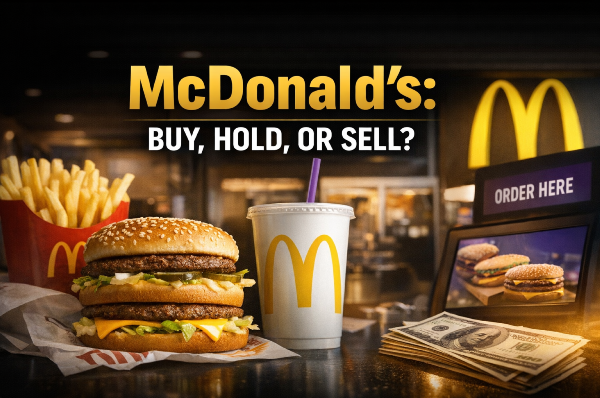









McDonald’s is one of the most recognizable restaurant companies on the planet, but the real question is simple: is the stock worth buying today? Welcome back to the Food Fund, where we break down the numbers behind the world’s biggest food, beverage, and restaurant brands. If you own McDonald’s—or you’re thinking about it—this deep dive will help you understand exactly what you’re getting into.
Let’s start with the basics: price action. Over the last year, McDonald’s delivered an 8% CAGR. Zoom out to five years, and you get the same 8% CAGR. It’s not a rocket ship, but it’s steady. That’s the theme with McDonald’s: slow, predictable appreciation. For some investors, that’s comforting. For others, it’s a sign that the company’s best growth days may be behind it.
Market share is another critical factor for restaurant stocks. According to the dashboard referenced in the transcript, McDonald’s is the second‑largest fast‑food company behind Starbucks. But here’s the issue: McDonald’s isn’t growing its share of the market. Today, it holds 3.16% of the public food, beverage, and restaurant market. Five years ago, it was 3.19%. That’s a 0.3% CAGR decline. The good news? Market share bottomed in 2022 and has been climbing since. The bad news? It still hasn’t recovered to 2021 levels.
This is the kind of stagnation long‑term investors need to pay attention to.
Market Share & Price Performance Snapshot
Now let’s dig into the fundamentals. McDonald’s gross margin sits at 57%, which is excellent for a fast‑food chain. This margin strength is one of the reasons McDonald’s has remained a global powerhouse for decades. Revenue has grown at a 3% CAGR over the past five years, reaching $26.1 billion. It’s slow, but it’s consistent—another recurring theme.
Cash flow tells a more complicated story. Operating cash flow increased at a 2% CAGR, but capex worsened at an 11% CAGR. That means free cash flow actually declined at a 1% CAGR. Capex is the culprit here. McDonald’s is investing heavily in modernization, digital ordering, and store upgrades. These investments may pay off long‑term, but right now they’re dragging on free cash flow.
One bright spot is share buybacks. Weighted average shares outstanding dropped from 751.8 million in 2021 to 718.9 million today. That’s exactly what shareholders want to see—McDonald’s consistently returns capital to investors.
Return on invested capital (ROIC) is another important metric. McDonald’s went from 17.4% in 2021 to 17.1% most recently. That’s still strong, but the slight decline shows management has become a bit less efficient with capital deployment.
Key Fundamental Metrics
Operational efficiency is one area where McDonald’s shines. The cash conversion cycle improved dramatically from 3 days to -71 days. That’s elite performance. A negative cash conversion cycle means McDonald’s gets paid by customers long before it pays suppliers. This is a major advantage in the restaurant industry.
Debt levels remain manageable. Net debt to EBITDA rose slightly from 3.6 to 3.8. That’s not ideal, but it’s still within industry norms. McDonald’s has always carried a sizable debt load, and as long as cash flow remains stable, this level is not alarming.
So far, McDonald’s looks like a fair company—not exceptional, not terrible. But how does it stack up against the gold standard, the S&P 500?
If you invested $10,000 in McDonald’s, it would have grown to $32,031. The same investment in the S&P 500 would be worth $36,399. That’s an annualized return of 12.9% for McDonald’s versus 14.4% for the S&P. McDonald’s also had slightly higher volatility and worse risk‑adjusted returns. The S&P simply outperformed.
Still, there were moments in the past decade when McDonald’s beat the market. But those moments were the exception, not the rule.
McDonald’s vs. S&P 500
McDonald’s history is legendary. Founded in 1940 by the McDonald brothers, the company was transformed by Ray Kroc into a global franchising empire. Today, McDonald’s employs 150,000 people and serves millions daily. The brand is iconic, the menu is familiar, and the business model is proven.
But the transcript makes one thing clear: McDonald’s growth days are behind it. The proprietary scoring system used in the video gives McDonald’s a 4 out of 10. That’s not a disaster, but it’s not a ringing endorsement either.
Let’s break down the final scoring inputs:
The PEG ratio is especially important. A PEG of 3.6 suggests McDonald’s is expensive relative to its expected earnings growth. That’s a red flag for value‑oriented investors.
The transcript also points out that rising input costs and lack of innovation have slowed growth. McDonald’s is no longer the fast‑growing, culture‑shaping brand it once was. It’s now a stable, slow‑moving dividend payer.
For investors seeking low volatility and predictable returns, McDonald’s still has appeal. But for growth‑oriented investors, the opportunity cost may be too high.
Final Verdict: Buy, Hold, or Sell?
Based strictly on the transcript’s data and scoring:
McDonald’s is a HOLD.
It’s stable, reliable, and shareholder‑friendly—but overvalued and slow‑growing. Growth investors may want to look elsewhere, while conservative investors may appreciate the consistency.
If you believe McDonald’s can innovate again or benefit from global expansion, you might lean toward a buy. If you think stagnation continues, you might lean toward a sell. But based on the our assessment, MCD is a HOLD.
https://youtu.be/u9tbQGVES_c?si=XrAs4IL0NX-VXIZq