🔑 Key Takeaways: Japanese vs Korean Auto Manufacturers
🚗 Long-term reliability still favors Japanese automakers
Japanese brands like Toyota (TM) and Honda (HMC) continue to lead in long-term durability, resale value, and mechanical consistency. Their slower, incremental engineering approach reduces risk and supports high-mileage performance, making them a strong choice for long-term ownership and conservative investing.
📈 Korean automakers prioritize faster growth and innovation
Hyundai (HYMTF) and Kia (KIMTF) focus on rapid design cycles, advanced features, and aggressive global expansion. This strategy drives faster innovation and stronger short-term appeal, but also creates more volatility in both vehicle perception and stock performance.
💰 Stock behavior reflects two very different investment styles
Japanese auto stocks tend to behave like stable, dividend-focused compounding assets, while Korean auto stocks act more like growth-oriented equities tied to innovation cycles and market momentum. This creates a clear split between stability (Japan) and growth potential (Korea).
⚖️ The real decision is about time horizon, not quality
The gap in vehicle quality between Japanese and Korean manufacturers has narrowed significantly. The real difference now lies in trade-offs: Japanese brands favor long-term predictability, while Korean brands prioritize speed, technology, and rapid value delivery.
Japanese vs Korean Auto Manufacturers: A Clear Investment + Ownership Breakdown
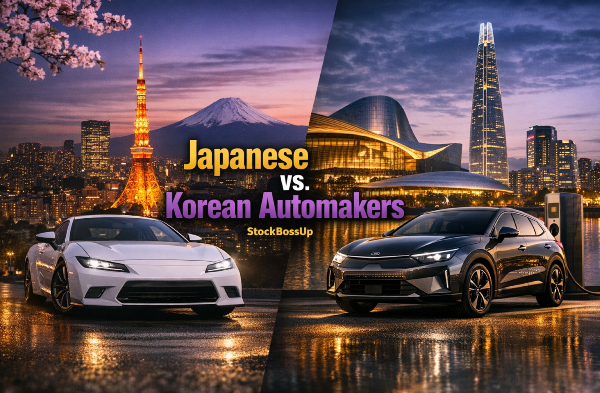
The global auto industry is often framed as a Japan vs Korea matchup. On one side are long-established Japanese automakers known for reliability and long-term engineering discipline. On the other are fast-growing Korean automakers known for design, technology, and value.
At first glance, the comparison seems simple. Japanese cars feel more durable. Korean cars feel more modern.
But there is a deeper problem most people miss.
A car purchase and a stock investment are both long-term commitments. The real question is not which is “better,” but which system performs better over time under real-world pressure—maintenance, depreciation, market cycles, and innovation speed.
By the end of this breakdown, the answer becomes clearer—but the trade-offs are not obvious at the start.
Why Are Japanese and Korean Auto Stocks Always Compared?
Japan and South Korea dominate global automotive exports, especially in affordable and mid-range segments. Their companies compete directly in the same markets, which makes comparison unavoidable for both consumers and investors.
Key Japanese auto stocks:
- TM — Toyota Motor Corporation
- HMC — Honda Motor Company
- NSANY — Nissan Motor Co.
- MZDAY — Mazda Motor Corporation
- FUJHY — Subaru Corporation
- SZKMY — Suzuki Motor Corporation
Key Korean auto stocks:
- HYMTF — Hyundai Motor Company
- KIMTF — Kia Corporation
These companies are not just competing on cars. They represent two different industrial strategies:
- Japan: stability and long-term refinement
- Korea: rapid innovation and global expansion
Why Do Japanese Automakers Focus on Stability Over Speed?
Japanese automakers built their reputation on precision engineering and slow, controlled improvement cycles.
TM is the clearest example of this approach. Toyota prioritizes hybrid efficiency, reliability, and long product lifecycles. Instead of redesigning platforms frequently, it improves existing systems gradually.
HMC follows a similar path, balancing global scale with conservative engineering decisions.
Japanese manufacturers tend to:
- Reduce mechanical risk through gradual updates
- Maintain stable global supply chains
- Focus on long-term durability over fast redesigns
This creates vehicles that often age slowly and remain dependable for high-mileage use.
How Did Korean Automakers Become Fast Global Competitors?
Korean automakers took a very different path. Instead of slow refinement, they focused on aggressive expansion and rapid modernization.
HYMTF and KIMTF represent this strategy clearly.
Hyundai and Kia invested heavily in:
- Rapid model redesign cycles
- Global design studios
- Feature-rich vehicles at lower prices
- Long warranty programs to build trust
Hyundai’s transformation from a low-cost brand into a global competitor in less than two decades is one of the fastest industrial turnarounds in modern auto history.
How Do Japanese vs Korean Auto Stocks Compare Financially?
| Region |
Stocks |
Volatility |
Dividend Style |
Growth Pattern |
| Japan |
TM, HMC, NSANY |
Lower |
Stable dividends |
Slow, steady |
| Korea |
HYMTF, KIMTF |
Higher |
Moderate |
Fast growth cycles |
Japanese stocks behave more like long-term compounding assets. Korean stocks behave more like cyclical growth stocks tied to product innovation and demand shifts.
Why Do Japanese Automakers Still Lead in Reliability Perception?
Even as Korean automakers improve, Japanese brands still dominate long-term reliability perception.
TM benefits from decades of consistent engineering standards and global trust in durability.
HMC also benefits from stable platform development and conservative design cycles.
Japanese automakers tend to extend vehicle platforms longer, improving them incrementally rather than replacing them frequently. This reduces variability and long-term mechanical risk.
Why Are Korean Auto Stocks More Volatile?
HYMTF and KIMTF tend to move faster in both directions.
They react strongly to:
- EV demand cycles
- Semiconductor shortages
- Global pricing shifts
- Design refresh success or failure
This creates stronger upside during growth phases but also sharper corrections during slowdowns.
How Do EV Strategies Differ Between Japan and Korea?
Electric vehicles highlight the biggest strategic divide between the two regions.
Japanese automakers, including TM, have focused heavily on hybrid systems before fully transitioning to EV dominance.
Korean automakers have taken a more aggressive EV-first approach:
- Dedicated EV platforms
- Fast-charging systems
- Rapid global rollout of electric models
Japan: gradual EV transition with stable cash flow
Korea: rapid EV expansion with higher growth potential
Which Auto Stocks Perform Better for Dividends?
For income-focused investors, Japanese automakers generally offer stronger consistency.
TM and HMC are known for steady dividend policies supported by stable global sales.
Korean automakers like HYMTF and KIMTF tend to reinvest more earnings into expansion and innovation, which limits dividend yield but supports growth.
Why Do Korean Cars Feel More Modern?
Korean automakers focus heavily on visible innovation.
This includes:
- Large digital dashboards
- Advanced driver assistance systems
- Bold exterior styling updates
- High-end features in lower trims
Japanese automakers prioritize longevity and usability over rapid redesign cycles.
Korean vehicles feel newer faster, while Japanese vehicles feel consistent longer.
How Do Global Expansion Strategies Differ?
Japanese automakers already have deeply established global systems.
TM and HMC operate mature supply chains across North America, Europe, and Asia.
Korean automakers are still in a more aggressive expansion phase, especially in EV markets and premium branding.
Hyundai’s Genesis brand represents its push into luxury competition against established German automakers.
Why Resale Value Still Favors Japanese Brands
Resale value reflects long-term trust more than short-term innovation.
Japanese vehicles tend to retain value better due to:
- Strong reliability reputation
- High mileage durability
- Consistent demand in used markets
Korean vehicles have improved significantly, but older model perception still affects resale pricing in many regions.
Final Answer: Which Side Actually Wins?
The real difference between Japanese and Korean automakers is not quality alone—it is philosophy.
Japanese automakers like TM and HMC prioritize stability, predictability, and long-term compounding value.
Korean automakers like HYMTF and KIMTF prioritize speed, innovation, and rapid global expansion.
One system rewards patience. The other rewards momentum.
The surprising truth is that vehicle quality between the two regions is now much closer than most people assume. The real separation still comes from financial behavior, product cycles, and long-term risk tolerance.
The decision ultimately comes down to whether you value steady compounding over time or faster innovation with more variability along the way.









🔑 Key Takeaways: Japanese vs Korean Auto Manufacturers
🚗 Long-term reliability still favors Japanese automakers
Japanese brands like Toyota (TM) and Honda (HMC) continue to lead in long-term durability, resale value, and mechanical consistency. Their slower, incremental engineering approach reduces risk and supports high-mileage performance, making them a strong choice for long-term ownership and conservative investing.
📈 Korean automakers prioritize faster growth and innovation
Hyundai (HYMTF) and Kia (KIMTF) focus on rapid design cycles, advanced features, and aggressive global expansion. This strategy drives faster innovation and stronger short-term appeal, but also creates more volatility in both vehicle perception and stock performance.
💰 Stock behavior reflects two very different investment styles
Japanese auto stocks tend to behave like stable, dividend-focused compounding assets, while Korean auto stocks act more like growth-oriented equities tied to innovation cycles and market momentum. This creates a clear split between stability (Japan) and growth potential (Korea).
⚖️ The real decision is about time horizon, not quality
The gap in vehicle quality between Japanese and Korean manufacturers has narrowed significantly. The real difference now lies in trade-offs: Japanese brands favor long-term predictability, while Korean brands prioritize speed, technology, and rapid value delivery.
Japanese vs Korean Auto Manufacturers: A Clear Investment + Ownership Breakdown
The global auto industry is often framed as a Japan vs Korea matchup. On one side are long-established Japanese automakers known for reliability and long-term engineering discipline. On the other are fast-growing Korean automakers known for design, technology, and value.
At first glance, the comparison seems simple. Japanese cars feel more durable. Korean cars feel more modern.
But there is a deeper problem most people miss.
A car purchase and a stock investment are both long-term commitments. The real question is not which is “better,” but which system performs better over time under real-world pressure—maintenance, depreciation, market cycles, and innovation speed.
By the end of this breakdown, the answer becomes clearer—but the trade-offs are not obvious at the start.
Why Are Japanese and Korean Auto Stocks Always Compared?
Japan and South Korea dominate global automotive exports, especially in affordable and mid-range segments. Their companies compete directly in the same markets, which makes comparison unavoidable for both consumers and investors.
Key Japanese auto stocks:
Key Korean auto stocks:
These companies are not just competing on cars. They represent two different industrial strategies:
Why Do Japanese Automakers Focus on Stability Over Speed?
Japanese automakers built their reputation on precision engineering and slow, controlled improvement cycles.
TM is the clearest example of this approach. Toyota prioritizes hybrid efficiency, reliability, and long product lifecycles. Instead of redesigning platforms frequently, it improves existing systems gradually.
HMC follows a similar path, balancing global scale with conservative engineering decisions.
Japanese manufacturers tend to:
This creates vehicles that often age slowly and remain dependable for high-mileage use.
How Did Korean Automakers Become Fast Global Competitors?
Korean automakers took a very different path. Instead of slow refinement, they focused on aggressive expansion and rapid modernization.
HYMTF and KIMTF represent this strategy clearly.
Hyundai and Kia invested heavily in:
Hyundai’s transformation from a low-cost brand into a global competitor in less than two decades is one of the fastest industrial turnarounds in modern auto history.
How Do Japanese vs Korean Auto Stocks Compare Financially?
Japanese stocks behave more like long-term compounding assets. Korean stocks behave more like cyclical growth stocks tied to product innovation and demand shifts.
Why Do Japanese Automakers Still Lead in Reliability Perception?
Even as Korean automakers improve, Japanese brands still dominate long-term reliability perception.
TM benefits from decades of consistent engineering standards and global trust in durability.
HMC also benefits from stable platform development and conservative design cycles.
Japanese automakers tend to extend vehicle platforms longer, improving them incrementally rather than replacing them frequently. This reduces variability and long-term mechanical risk.
Why Are Korean Auto Stocks More Volatile?
HYMTF and KIMTF tend to move faster in both directions.
They react strongly to:
This creates stronger upside during growth phases but also sharper corrections during slowdowns.
How Do EV Strategies Differ Between Japan and Korea?
Electric vehicles highlight the biggest strategic divide between the two regions.
Japanese automakers, including TM, have focused heavily on hybrid systems before fully transitioning to EV dominance.
Korean automakers have taken a more aggressive EV-first approach:
Japan: gradual EV transition with stable cash flow
Korea: rapid EV expansion with higher growth potential
Which Auto Stocks Perform Better for Dividends?
For income-focused investors, Japanese automakers generally offer stronger consistency.
TM and HMC are known for steady dividend policies supported by stable global sales.
Korean automakers like HYMTF and KIMTF tend to reinvest more earnings into expansion and innovation, which limits dividend yield but supports growth.
Why Do Korean Cars Feel More Modern?
Korean automakers focus heavily on visible innovation.
This includes:
Japanese automakers prioritize longevity and usability over rapid redesign cycles.
Korean vehicles feel newer faster, while Japanese vehicles feel consistent longer.
How Do Global Expansion Strategies Differ?
Japanese automakers already have deeply established global systems.
TM and HMC operate mature supply chains across North America, Europe, and Asia.
Korean automakers are still in a more aggressive expansion phase, especially in EV markets and premium branding.
Hyundai’s Genesis brand represents its push into luxury competition against established German automakers.
Why Resale Value Still Favors Japanese Brands
Resale value reflects long-term trust more than short-term innovation.
Japanese vehicles tend to retain value better due to:
Korean vehicles have improved significantly, but older model perception still affects resale pricing in many regions.
Final Answer: Which Side Actually Wins?
The real difference between Japanese and Korean automakers is not quality alone—it is philosophy.
Japanese automakers like TM and HMC prioritize stability, predictability, and long-term compounding value.
Korean automakers like HYMTF and KIMTF prioritize speed, innovation, and rapid global expansion.
One system rewards patience. The other rewards momentum.
The surprising truth is that vehicle quality between the two regions is now much closer than most people assume. The real separation still comes from financial behavior, product cycles, and long-term risk tolerance.
The decision ultimately comes down to whether you value steady compounding over time or faster innovation with more variability along the way.