Last updated on June 23rd 2026 by Noah Brody
🔑 Key Takeaways
🛒 Internet retailers and traditional retailers operate very different business models
Internet retail companies typically focus on digital platforms, logistics networks, and scalable technology, while traditional retailers rely heavily on physical stores, real estate, and in-person customer experiences.
📈 Internet retail stocks often offer higher growth potential but can carry higher valuations
Companies such as Amazon, MercadoLibre, Shopify, and Alibaba have historically attracted investors seeking growth. Traditional retailers often trade at lower valuation multiples but may offer more stable cash flows and dividends.
🏬 Traditional retailers still possess important advantages despite e-commerce growth
Physical stores provide immediate product access, customer service, and local market presence. Many successful retailers now combine online and offline channels to create hybrid shopping experiences.
💰 Investors should evaluate profitability, competitive advantages, and adaptability
The strongest investment opportunities often come from companies that successfully adapt to changing consumer habits, whether they operate primarily online, through stores, or through both channels.
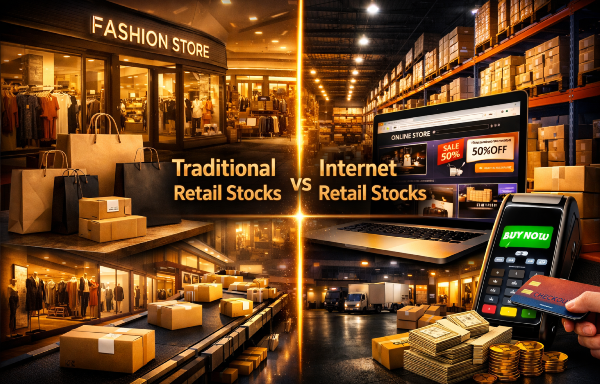
Internet Retail Stocks vs Traditional Retail Stocks
A Tale of Two Shopping Carts
The retail industry has experienced one of the biggest transformations in modern business history.
A generation ago, most shopping happened in malls, department stores, grocery stores, and shopping centers. Today, millions of consumers browse products while sitting on a couch, waiting at an airport, or standing in line for coffee.
For investors, this shift created an entirely new category of stocks. Internet retail companies emerged as some of the market's fastest-growing businesses, while traditional retailers faced pressure to adapt.
The interesting part is that this is not a simple story where one side wins and the other loses.
Both business models have strengths, weaknesses, and opportunities that investors should understand.
Understanding the Core Difference
At the highest level, internet retailers sell products primarily through digital channels.
Traditional retailers rely on physical stores as their primary customer touchpoint.
That difference sounds simple, but it affects nearly every aspect of the business.
Internet retailers invest heavily in software, fulfillment centers, digital marketing, and logistics. Traditional retailers invest heavily in store locations, employees, merchandising, and real estate.
Each model comes with unique costs and competitive advantages.
| Category |
Internet Retail |
Traditional Retail |
| Sales Channel |
Online |
Physical Stores |
| Customer Reach |
Global |
Local to Regional |
| Real Estate Needs |
Low |
High |
| Logistics Dependence |
Very High |
Moderate |
| Store Labor Costs |
Low |
High |
One interesting reality is that many consumers now check online reviews before visiting a physical store, meaning even traditional retail purchases often begin in the digital world.
Why Internet Retail Stocks Captured Investor Attention
Internet retail companies gained popularity because they offered something investors love: scalability.
A physical retailer that wants to expand often needs new stores, new employees, and additional inventory.
An internet retailer can potentially reach millions of new customers with relatively little physical expansion.
This scalability has helped companies such as Amazon, MercadoLibre, Alibaba, Shopify, and PDD Holdings grow at remarkable rates.
Digital platforms also create opportunities for additional revenue streams.
Many internet retailers generate income from advertising, subscriptions, logistics services, payment processing, and marketplace fees.
These high-margin businesses can significantly boost profitability over time.
The Enduring Strength of Traditional Retail
Despite years of e-commerce growth, traditional retail is far from obsolete.
People still want to see furniture before buying it. They still need groceries immediately. They still visit home improvement stores when a pipe bursts on a Saturday afternoon.
Physical stores provide convenience that online shopping cannot always match.
Retailers such as Walmart, Costco, Target, Home Depot, and Lowe's continue generating enormous revenue through store-based operations.
The ability to touch products, ask questions, and leave with purchases immediately remains a powerful advantage.
Some shopping experiences simply work better in person.
| Traditional Retail Advantage |
Why It Matters |
| Immediate Product Access |
No shipping wait |
| Customer Service |
In-person assistance |
| Product Inspection |
Better buying confidence |
| Local Presence |
Community connection |
| Impulse Purchases |
Higher basket sizes |
Retail stores may not be disappearing. They may simply be evolving.
Profit Margins Tell an Interesting Story
Revenue often gets the headlines, but margins tell a deeper story.
Internet retailers can sometimes operate with lower overhead because they do not need thousands of storefronts.
However, they face significant logistics expenses, including shipping, fulfillment, returns, and warehousing.
Traditional retailers carry substantial store costs but can sometimes avoid expensive last-mile delivery challenges.
The result is that profitability varies widely across both sectors.
A large e-commerce company can generate enormous revenue while producing relatively thin margins.
Meanwhile, a well-run traditional retailer may generate steady profits with slower growth.
For investors, margin trends often reveal more than revenue growth alone.
Logistics Has Become the New Storefront
For internet retailers, logistics has become what storefronts once were for traditional retailers.
Fast delivery creates customer loyalty.
Reliable fulfillment improves retention.
Efficient inventory management strengthens profitability.
Amazon's fulfillment network, MercadoLibre's logistics ecosystem, and JD.com's delivery infrastructure illustrate how logistics can become a competitive moat.
A warehouse may not look as exciting as a flagship store, but in modern retail, it can be just as valuable.
One lesser-known industry trend is that some fulfillment centers process hundreds of thousands of products daily using advanced robotics and automation systems that barely existed a decade ago.
Traditional Retailers Fight Back With Omnichannel Strategies
Many traditional retailers refused to stand still while e-commerce expanded.
Instead, they embraced omnichannel strategies.
The goal is simple: meet customers wherever they want to shop.
Walmart has invested heavily in online ordering and curbside pickup. Target has expanded same-day fulfillment options. Best Buy integrated digital and physical experiences more closely.
The result is a blending of retail models.
| Omnichannel Feature |
Customer Benefit |
| Buy Online, Pick Up In Store |
Speed |
| Same-Day Delivery |
Convenience |
| Mobile Shopping Apps |
Accessibility |
| In-Store Returns |
Simplicity |
| Digital Loyalty Programs |
Engagement |
Increasingly, the battle is not online versus offline. It is about who delivers the best overall customer experience.
Valuation Differences Matter
Internet retail stocks often trade at higher valuation multiples than traditional retailers.
Investors typically expect faster growth from digital-first companies.
That expectation can lead to premium valuations.
Traditional retailers often receive lower valuation multiples because growth tends to be slower and more predictable.
However, lower valuations sometimes create opportunities.
A company growing at 5% annually may still be attractive if investors can purchase shares at a reasonable price and collect dividends along the way.
The relationship between growth and valuation is one of the most important factors investors should monitor.
Economic Cycles Affect Both Sectors Differently
Consumer spending drives both internet retail and traditional retail.
However, different categories can perform differently during economic slowdowns.
Discount retailers often perform well when consumers become more price conscious.
Luxury retailers may experience pressure when discretionary spending declines.
Internet retailers sometimes benefit from convenience-focused shopping behavior, while physical retailers may benefit from immediate availability.
| Economic Factor |
Internet Retail Impact |
Traditional Retail Impact |
| Consumer Confidence |
High |
High |
| Inflation |
Moderate |
High |
| Fuel Costs |
Logistics Pressure |
Store Traffic Impact |
| Interest Rates |
Growth Stock Pressure |
Mixed Effects |
| Employment Trends |
Important |
Important |
Neither business model is immune to economic cycles.
The strongest companies are usually those with loyal customers and flexible operations.
Where Investors May Find the Best Opportunities
The most attractive retail investments are not always found at either extreme.
Many successful companies now combine digital capabilities with physical assets.
Amazon has experimented with physical locations. Walmart continues expanding digital services. Target has become increasingly effective at blending online and store-based shopping.
The future of retail may belong to businesses that combine the strengths of both models.
Investors should focus on factors such as customer loyalty, logistics capabilities, profitability, market share, and management execution.
The label "internet retailer" or "traditional retailer" matters less than the company's ability to adapt.
The Future May Not Be Online or Offline
The retail industry's evolution has created opportunities across both internet retail and traditional retail stocks.
Internet retailers benefit from scalability, technology, and expanding digital ecosystems. Traditional retailers benefit from physical presence, immediate fulfillment, and established customer relationships.
The strongest companies increasingly borrow ideas from each other.
Traditional retailers are becoming more digital. Internet retailers are investing in logistics, fulfillment, and sometimes even physical locations.
For investors, the most important question is not whether a company sells online or through stores.
The more important question is whether that company can continue attracting customers, generating profits, and adapting to the next shift in consumer behavior.
The winners of the next decade may not fit neatly into either category. They may be the companies that successfully combine the best aspects of both worlds.
🚀 Expand Your Edge: Elite Internet Retail & E-Commerce Intelligence
Ready to capitalize on the future of digital commerce? Our Internet Retail Investor Intelligence Hub is designed to help investors analyze the companies, technologies, and trends reshaping global shopping. From foundational industry research and stock selection to AI, logistics, valuation, and international growth, explore the curated silos below to uncover your next investment opportunity.
🌐 Industry Fundamentals & Market Leaders
📊 Financial Strength & Shareholder Returns
🤖 Technology, AI & Digital Transformation
🚚 Logistics, Fulfillment & Supply Chain Intelligence
🌍 Global Expansion & Market Opportunities
⚠️ Risk Management & Economic Trends
🔍 Competitive Analysis & Advanced Research





Last updated on June 23rd 2026 by Noah Brody
🔑 Key Takeaways
🛒 Internet retailers and traditional retailers operate very different business models
Internet retail companies typically focus on digital platforms, logistics networks, and scalable technology, while traditional retailers rely heavily on physical stores, real estate, and in-person customer experiences.
📈 Internet retail stocks often offer higher growth potential but can carry higher valuations
Companies such as Amazon, MercadoLibre, Shopify, and Alibaba have historically attracted investors seeking growth. Traditional retailers often trade at lower valuation multiples but may offer more stable cash flows and dividends.
🏬 Traditional retailers still possess important advantages despite e-commerce growth
Physical stores provide immediate product access, customer service, and local market presence. Many successful retailers now combine online and offline channels to create hybrid shopping experiences.
💰 Investors should evaluate profitability, competitive advantages, and adaptability
The strongest investment opportunities often come from companies that successfully adapt to changing consumer habits, whether they operate primarily online, through stores, or through both channels.
Internet Retail Stocks vs Traditional Retail Stocks
A Tale of Two Shopping Carts
The retail industry has experienced one of the biggest transformations in modern business history.
A generation ago, most shopping happened in malls, department stores, grocery stores, and shopping centers. Today, millions of consumers browse products while sitting on a couch, waiting at an airport, or standing in line for coffee.
For investors, this shift created an entirely new category of stocks. Internet retail companies emerged as some of the market's fastest-growing businesses, while traditional retailers faced pressure to adapt.
The interesting part is that this is not a simple story where one side wins and the other loses.
Both business models have strengths, weaknesses, and opportunities that investors should understand.
Understanding the Core Difference
At the highest level, internet retailers sell products primarily through digital channels.
Traditional retailers rely on physical stores as their primary customer touchpoint.
That difference sounds simple, but it affects nearly every aspect of the business.
Internet retailers invest heavily in software, fulfillment centers, digital marketing, and logistics. Traditional retailers invest heavily in store locations, employees, merchandising, and real estate.
Each model comes with unique costs and competitive advantages.
One interesting reality is that many consumers now check online reviews before visiting a physical store, meaning even traditional retail purchases often begin in the digital world.
Why Internet Retail Stocks Captured Investor Attention
Internet retail companies gained popularity because they offered something investors love: scalability.
A physical retailer that wants to expand often needs new stores, new employees, and additional inventory.
An internet retailer can potentially reach millions of new customers with relatively little physical expansion.
This scalability has helped companies such as Amazon, MercadoLibre, Alibaba, Shopify, and PDD Holdings grow at remarkable rates.
Digital platforms also create opportunities for additional revenue streams.
Many internet retailers generate income from advertising, subscriptions, logistics services, payment processing, and marketplace fees.
These high-margin businesses can significantly boost profitability over time.
The Enduring Strength of Traditional Retail
Despite years of e-commerce growth, traditional retail is far from obsolete.
People still want to see furniture before buying it. They still need groceries immediately. They still visit home improvement stores when a pipe bursts on a Saturday afternoon.
Physical stores provide convenience that online shopping cannot always match.
Retailers such as Walmart, Costco, Target, Home Depot, and Lowe's continue generating enormous revenue through store-based operations.
The ability to touch products, ask questions, and leave with purchases immediately remains a powerful advantage.
Some shopping experiences simply work better in person.
Retail stores may not be disappearing. They may simply be evolving.
Profit Margins Tell an Interesting Story
Revenue often gets the headlines, but margins tell a deeper story.
Internet retailers can sometimes operate with lower overhead because they do not need thousands of storefronts.
However, they face significant logistics expenses, including shipping, fulfillment, returns, and warehousing.
Traditional retailers carry substantial store costs but can sometimes avoid expensive last-mile delivery challenges.
The result is that profitability varies widely across both sectors.
A large e-commerce company can generate enormous revenue while producing relatively thin margins.
Meanwhile, a well-run traditional retailer may generate steady profits with slower growth.
For investors, margin trends often reveal more than revenue growth alone.
Logistics Has Become the New Storefront
For internet retailers, logistics has become what storefronts once were for traditional retailers.
Fast delivery creates customer loyalty.
Reliable fulfillment improves retention.
Efficient inventory management strengthens profitability.
Amazon's fulfillment network, MercadoLibre's logistics ecosystem, and JD.com's delivery infrastructure illustrate how logistics can become a competitive moat.
A warehouse may not look as exciting as a flagship store, but in modern retail, it can be just as valuable.
One lesser-known industry trend is that some fulfillment centers process hundreds of thousands of products daily using advanced robotics and automation systems that barely existed a decade ago.
Traditional Retailers Fight Back With Omnichannel Strategies
Many traditional retailers refused to stand still while e-commerce expanded.
Instead, they embraced omnichannel strategies.
The goal is simple: meet customers wherever they want to shop.
Walmart has invested heavily in online ordering and curbside pickup. Target has expanded same-day fulfillment options. Best Buy integrated digital and physical experiences more closely.
The result is a blending of retail models.
Increasingly, the battle is not online versus offline. It is about who delivers the best overall customer experience.
Valuation Differences Matter
Internet retail stocks often trade at higher valuation multiples than traditional retailers.
Investors typically expect faster growth from digital-first companies.
That expectation can lead to premium valuations.
Traditional retailers often receive lower valuation multiples because growth tends to be slower and more predictable.
However, lower valuations sometimes create opportunities.
A company growing at 5% annually may still be attractive if investors can purchase shares at a reasonable price and collect dividends along the way.
The relationship between growth and valuation is one of the most important factors investors should monitor.
Economic Cycles Affect Both Sectors Differently
Consumer spending drives both internet retail and traditional retail.
However, different categories can perform differently during economic slowdowns.
Discount retailers often perform well when consumers become more price conscious.
Luxury retailers may experience pressure when discretionary spending declines.
Internet retailers sometimes benefit from convenience-focused shopping behavior, while physical retailers may benefit from immediate availability.
Neither business model is immune to economic cycles.
The strongest companies are usually those with loyal customers and flexible operations.
Where Investors May Find the Best Opportunities
The most attractive retail investments are not always found at either extreme.
Many successful companies now combine digital capabilities with physical assets.
Amazon has experimented with physical locations. Walmart continues expanding digital services. Target has become increasingly effective at blending online and store-based shopping.
The future of retail may belong to businesses that combine the strengths of both models.
Investors should focus on factors such as customer loyalty, logistics capabilities, profitability, market share, and management execution.
The label "internet retailer" or "traditional retailer" matters less than the company's ability to adapt.
The Future May Not Be Online or Offline
The retail industry's evolution has created opportunities across both internet retail and traditional retail stocks.
Internet retailers benefit from scalability, technology, and expanding digital ecosystems. Traditional retailers benefit from physical presence, immediate fulfillment, and established customer relationships.
The strongest companies increasingly borrow ideas from each other.
Traditional retailers are becoming more digital. Internet retailers are investing in logistics, fulfillment, and sometimes even physical locations.
For investors, the most important question is not whether a company sells online or through stores.
The more important question is whether that company can continue attracting customers, generating profits, and adapting to the next shift in consumer behavior.
The winners of the next decade may not fit neatly into either category. They may be the companies that successfully combine the best aspects of both worlds.
🚀 Expand Your Edge: Elite Internet Retail & E-Commerce Intelligence
Ready to capitalize on the future of digital commerce? Our Internet Retail Investor Intelligence Hub is designed to help investors analyze the companies, technologies, and trends reshaping global shopping. From foundational industry research and stock selection to AI, logistics, valuation, and international growth, explore the curated silos below to uncover your next investment opportunity.
🌐 Industry Fundamentals & Market Leaders
📊 Financial Strength & Shareholder Returns
🤖 Technology, AI & Digital Transformation
🚚 Logistics, Fulfillment & Supply Chain Intelligence
🌍 Global Expansion & Market Opportunities
⚠️ Risk Management & Economic Trends
🔍 Competitive Analysis & Advanced Research