Manufacturing as a Competitive Battleground
Manufacturing excellence is one of the most critical competitive differentiators in the furnishings, fixtures, and appliances industry. Companies that invest in automation, advanced manufacturing technologies, and continuous process improvement achieve lower unit costs, superior quality consistency, faster production lead times, and greater supply chain resilience. In a sector where margins are under constant pressure from input cost inflation and competitive pricing, manufacturing innovation can be the difference between sector leadership and irrelevance.
Key Manufacturing Technologies Reshaping the Industry
Robotics and Automated Assembly
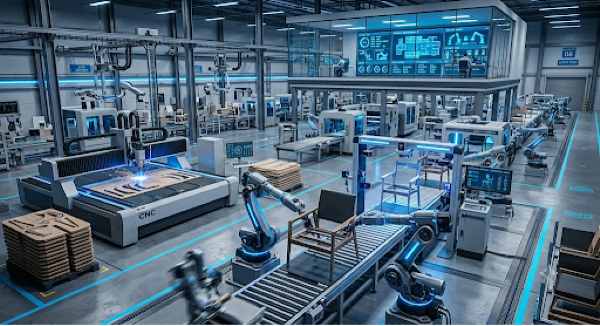
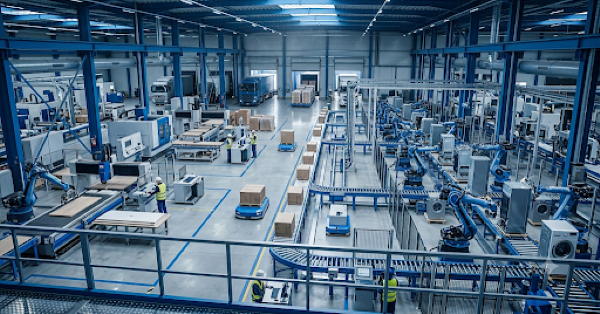
Industrial robotics are increasingly deployed across furniture cutting, appliance assembly, painting and finishing, and quality inspection processes. Robotic systems reduce labor costs, eliminate human error in repetitive tasks, improve throughput speed, and enable around-the-clock production. Appliance manufacturers like Whirlpool, Bosch, and LG have made major investments in robotic assembly lines to compete with lower-cost Asian manufacturers.
CNC Machining and Digital Fabrication
Computer numerical control (CNC) machining enables precision cutting of wood, metal, and composite materials to exact tolerances that were impossible with traditional manual machining. CNC technology dramatically reduces material waste, improves product consistency, and enables rapid customization of product dimensions and designs. Custom and semi-custom furniture manufacturers rely heavily on CNC capabilities to serve premium market segments profitably.
Additive Manufacturing and 3D Printing
Additive manufacturing is beginning to impact the fixtures and decorative hardware segment, enabling rapid prototyping and small-batch production of complex geometries that would be prohibitively expensive with traditional manufacturing. While not yet deployed at mass production scale in the sector, 3D printing capabilities are reducing new product development timelines and enabling greater design experimentation.
Investor Perspective on Manufacturing Investment
Investors should assess each company's capital expenditure patterns, automation levels, and manufacturing cost trends as indicators of long-term competitiveness. Companies that consistently invest in manufacturing innovation demonstrate commitment to maintaining cost competitiveness and quality differentiation. Reviewing fixed asset turnover ratios, gross margin trends, and management commentary on manufacturing efficiency initiatives provides important insight into operational excellence.
Conclusion
Manufacturing innovation is a critical and often overlooked competitive driver in the furnishings, fixtures, and appliances industry. Companies that lead in automation, precision manufacturing, and continuous process improvement will sustain superior cost structures and quality profiles that translate directly into durable competitive advantages and superior long-term shareholder returns.














Manufacturing as a Competitive Battleground
Manufacturing excellence is one of the most critical competitive differentiators in the furnishings, fixtures, and appliances industry. Companies that invest in automation, advanced manufacturing technologies, and continuous process improvement achieve lower unit costs, superior quality consistency, faster production lead times, and greater supply chain resilience. In a sector where margins are under constant pressure from input cost inflation and competitive pricing, manufacturing innovation can be the difference between sector leadership and irrelevance.
Key Manufacturing Technologies Reshaping the Industry
Robotics and Automated Assembly
Industrial robotics are increasingly deployed across furniture cutting, appliance assembly, painting and finishing, and quality inspection processes. Robotic systems reduce labor costs, eliminate human error in repetitive tasks, improve throughput speed, and enable around-the-clock production. Appliance manufacturers like Whirlpool, Bosch, and LG have made major investments in robotic assembly lines to compete with lower-cost Asian manufacturers.
CNC Machining and Digital Fabrication
Computer numerical control (CNC) machining enables precision cutting of wood, metal, and composite materials to exact tolerances that were impossible with traditional manual machining. CNC technology dramatically reduces material waste, improves product consistency, and enables rapid customization of product dimensions and designs. Custom and semi-custom furniture manufacturers rely heavily on CNC capabilities to serve premium market segments profitably.
Additive Manufacturing and 3D Printing
Additive manufacturing is beginning to impact the fixtures and decorative hardware segment, enabling rapid prototyping and small-batch production of complex geometries that would be prohibitively expensive with traditional manufacturing. While not yet deployed at mass production scale in the sector, 3D printing capabilities are reducing new product development timelines and enabling greater design experimentation.
Investor Perspective on Manufacturing Investment
Investors should assess each company's capital expenditure patterns, automation levels, and manufacturing cost trends as indicators of long-term competitiveness. Companies that consistently invest in manufacturing innovation demonstrate commitment to maintaining cost competitiveness and quality differentiation. Reviewing fixed asset turnover ratios, gross margin trends, and management commentary on manufacturing efficiency initiatives provides important insight into operational excellence.
Conclusion
Manufacturing innovation is a critical and often overlooked competitive driver in the furnishings, fixtures, and appliances industry. Companies that lead in automation, precision manufacturing, and continuous process improvement will sustain superior cost structures and quality profiles that translate directly into durable competitive advantages and superior long-term shareholder returns.