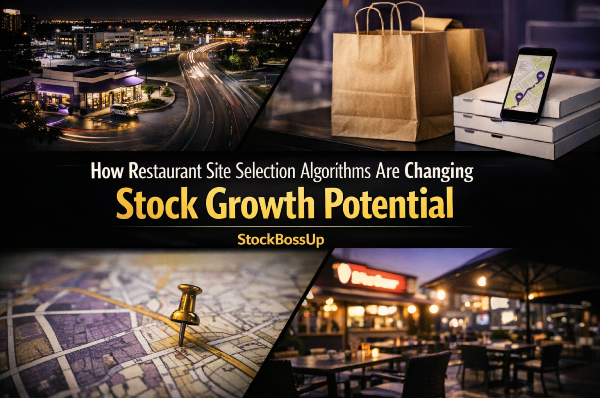
🔑 Key Takeaways: How Restaurant Site Selection Algorithms Are Changing Stock Growth Potential
🍽️ Data‑Driven Location Choices Are Replacing Guesswork
Modern restaurant chains now rely on algorithmic insights instead of intuition. These systems analyze millions of data points—traffic flow, delivery demand, and local spending—to pinpoint profitable sites. The result is fewer underperforming stores and stronger long‑term stock stability.
📊 Investor Confidence Grows With Predictable Expansion
Brands using advanced site selection tools show steadier same‑store sales and more consistent margins. Investors reward this predictability, viewing algorithm‑driven expansion as a sign of disciplined growth and lower risk exposure.
🚗 Delivery Zones and Cannibalization Maps Redefine Success
Algorithms now measure delivery demand and overlap between stores, revealing hidden opportunities and risks. Chains that optimize spacing and delivery coverage often outperform competitors who rely on outdated foot‑traffic models.
💡 Early‑Trend Detection Creates a Competitive Edge
Some systems can forecast neighborhood gentrification up to two years before rent spikes, allowing brands to secure prime locations early. This foresight translates into higher ROI and faster compounding growth for restaurant stocks.
Restaurant investors face a growing problem. Many brands still open new locations based on old habits, gut feelings, or outdated maps. These choices look fine on paper, yet some stores underperform for years. The real issue is that most investors cannot see the hidden forces that make one site thrive while another fails. The solution exists, but it only becomes clear once you understand how modern site selection algorithms work and why they are reshaping stock growth potential across the entire sector.
Why Do So Many Restaurants Still Choose the Wrong Locations?
Most people assume restaurants fail because of bad food or weak marketing. In reality, location mistakes are one of the biggest drivers of long‑term losses. A store placed just one block too far from foot traffic can miss thousands of potential customers each week. A site placed near the wrong mix of competitors can struggle even if the brand is strong.
Traditional site selection relied on:
- Local real estate brokers
- Manual traffic counts
- Demographic snapshots
- Manager intuition
These methods worked decades ago, but today’s markets shift too fast. Consumer behavior changes weekly. College towns empty out during breaks. Suburbs rise and fall. Even weather patterns influence demand.
This is where modern algorithms step in. They process millions of data points that humans cannot track on their own. They reveal patterns that were invisible before. And they help brands avoid costly mistakes that drag down stock performance.
What Hidden Data Points Are Algorithms Seeing That Humans Miss?
Algorithms do not just look at population or income. They scan layers of data that reveal how people actually move, spend, and behave. Some of the most powerful signals include:
- Real‑time mobile location data
- Drive‑time heat maps
- Delivery demand patterns
- Local worker density by hour
- Social media check‑ins
- Weather‑linked buying habits
- Competitor pricing shifts
- Parking availability patterns
One national chain discovered that customers were far more likely to visit on days when the local high school had home games. This pattern had gone unnoticed for years. Once the algorithm surfaced it, the brand adjusted staffing and marketing, boosting sales in several regions.
Another chain learned that stores near dog parks performed better than stores near regular parks. This was not because of the parks themselves, but because dog owners tend to buy more grab‑and‑go meals. This insight changed how the brand evaluated suburban sites.
These kinds of discoveries are now common. They help brands choose locations that match real behavior, not assumptions.
How Are These Algorithms Changing the Way Investors Judge Growth Potential?
Investors used to judge restaurant expansion by counting new stores. More stores meant more revenue. But today, investors look deeper. They want to know whether each new store is placed in a high‑probability success zone.
Algorithms help investors see:
- Whether a brand is expanding into strong demand pockets
- Whether new stores are cannibalizing older ones
- Whether the chain is avoiding high‑risk real estate
- Whether the brand is adapting to new consumer patterns
This shift matters because poorly placed stores drag down margins for years. They also reduce investor confidence. Brands that use advanced site selection tools tend to show steadier same‑store sales and more predictable growth.
Below is a simple comparison of two fictional restaurant chains and how their site selection strategies affect performance.
| Brand |
Site Selection Method |
Avg. New Store ROI (3 Years) |
Cannibalization Risk |
| Brand A |
Manual, intuition‑based |
8% |
High |
| Brand B |
Algorithm‑driven |
19% |
Low |
Brands using algorithms often outperform because they avoid the silent traps that hurt long‑term returns.
Why Do Some Algorithms Predict Foot Traffic Better Than Others?
Not all algorithms are equal. Some rely on outdated datasets or limited sources. The strongest systems combine multiple layers of real‑time data.
Key factors that improve accuracy include:
- Temporal modeling: Predicting how traffic changes by hour
- Seasonal patterns: Understanding school schedules, tourism waves, and weather cycles
- Micro‑geography: Measuring foot traffic on specific sidewalks, not just entire blocks
- Behavior clusters: Grouping customers by habits, not just demographics
One surprising fact is that some algorithms can detect when a neighborhood is about to gentrify up to two years before real estate prices rise. They do this by tracking small but consistent changes in foot traffic patterns, such as increased morning visits from remote workers.
This gives restaurant brands a major advantage. They can enter a neighborhood early, secure lower rents, and build loyalty before competitors arrive.
What Happens When Algorithms Predict the Wrong Outcome?
Even the best systems make mistakes. But the difference is how brands respond. Algorithm‑driven companies monitor performance in real time. If a store underperforms, they adjust:
- Menu mix
- Staffing levels
- Delivery radius
- Local promotions
- Operating hours
This rapid response reduces losses and protects margins. Traditional brands often wait months before noticing a problem.
Below is a comparison of how fast different types of brands react to early warning signs.
| Brand Type |
Time to Detect Underperformance |
Time to Adjust Strategy |
| Traditional |
3–6 months |
2–4 months |
| Algorithm‑Driven |
2–4 weeks |
1–2 weeks |
Speed matters. Faster adjustments mean fewer long‑term losses.
Why Are Delivery and Drive‑Thru Patterns Now More Important Than Foot Traffic?
The rise of delivery apps changed everything. A location with low foot traffic can still thrive if it sits inside a high‑demand delivery zone. Algorithms now map delivery “hot pockets” where order density is unusually high.
These zones often do not match traditional retail maps. For example:
- A quiet residential street may have high late‑night delivery demand.
- A business district may spike during lunch but drop sharply after 3 p.m.
- A college area may peak at midnight instead of noon.
One national chain discovered that its best delivery zones were not near campuses, but near large apartment complexes with young professionals. This insight changed its entire expansion strategy.
Another unique fact: some algorithms can predict delivery demand spikes based on local sports schedules, even when the games are away. Fans still order food at home, and the system learns these patterns.
Why Do Investors Care About “Cannibalization Maps” More Than Ever?
Cannibalization happens when a new store steals customers from an older store. This reduces total revenue and hurts stock performance. Algorithms now create cannibalization maps that show:
- Overlapping drive‑time zones
- Shared customer clusters
- Delivery radius conflicts
- Competing loyalty patterns
These maps help brands avoid placing stores too close together. They also help investors judge whether a chain is expanding responsibly.
Below is an example of how cannibalization risk changes based on store spacing.
| Distance Between Stores |
Cannibalization Risk |
Impact on Margins |
| 0.5 miles |
High |
Negative |
| 1 mile |
Moderate |
Neutral |
| 2+ miles |
Low |
Positive |
Brands that ignore these maps often see slower stock growth because their expansion strategy creates internal competition.
What Role Does Real Estate Cost Play in Algorithm‑Driven Decisions?
Algorithms do not just look at demand. They also weigh real estate costs. A high‑traffic area may look attractive, but if rent is too high, the store may struggle to stay profitable.
Modern systems calculate:
- Rent‑to‑revenue ratios
- Long‑term lease risk
- Local tax impact
- Utility cost patterns
- Seasonal rent fluctuations
This helps brands choose sites that balance demand with cost efficiency. Investors prefer companies that use these models because they reduce financial risk.
Why Are Some Brands Using “Predictive Clustering” to Plan Entire Regions?
Predictive clustering groups potential sites into zones that share similar traits. This helps brands plan entire regions instead of choosing sites one at a time.
Benefits include:
- More efficient marketing
- Better supply chain planning
- Stronger brand visibility
- Lower distribution costs
Investors like this approach because it creates smoother growth curves. Instead of random expansion, the brand grows in organized clusters that support each other.
What Does All This Mean for Long‑Term Stock Growth?
Restaurant stocks grow when brands open profitable stores, avoid costly mistakes, and adapt quickly to market changes. Site selection algorithms support all three goals.
They help brands:
- Enter strong markets early
- Avoid weak or overpriced locations
- Reduce cannibalization
- Improve delivery performance
- Adjust faster to real‑time data
- Build more stable regional clusters
Investors reward brands that show consistent, predictable growth. Algorithm‑driven site selection makes that possible.
So What Is the Real Reason Algorithms Are Changing Stock Growth Potential?
The real reason is simple. Algorithms remove the guesswork. They turn location strategy into a measurable, repeatable system. This reduces risk, improves margins, and creates a clearer path to long‑term growth.
Brands that embrace these tools gain a major advantage. They open stronger stores. They avoid costly mistakes. They adapt faster. And they build investor confidence with every new location.
As more restaurant companies adopt advanced site selection systems, the gap between data‑driven brands and traditional brands will continue to widen. For investors, understanding these algorithms is no longer optional. It is now one of the most important signals of future stock performance.
🏗️ Master the Terrain: Prime Restaurant Real Estate Insights
Unlock the hidden value in your portfolio by mastering the "where" and "how" of restaurant expansion. From high-traffic non-traditional sites to the algorithmic precision of modern site selection, explore how physical footprints dictate fiscal futures.
📍 Strategic Growth & Real Estate in Restaurant Businesses
Market Intel: In an era of shifting demographics, the transition from urban centers to optimized suburban drive-thrus is redefining long-term equity. Use the links above to deep dive into the data driving these shifts.









🔑 Key Takeaways: How Restaurant Site Selection Algorithms Are Changing Stock Growth Potential
🍽️ Data‑Driven Location Choices Are Replacing Guesswork
Modern restaurant chains now rely on algorithmic insights instead of intuition. These systems analyze millions of data points—traffic flow, delivery demand, and local spending—to pinpoint profitable sites. The result is fewer underperforming stores and stronger long‑term stock stability.📊 Investor Confidence Grows With Predictable Expansion
Brands using advanced site selection tools show steadier same‑store sales and more consistent margins. Investors reward this predictability, viewing algorithm‑driven expansion as a sign of disciplined growth and lower risk exposure.🚗 Delivery Zones and Cannibalization Maps Redefine Success
Algorithms now measure delivery demand and overlap between stores, revealing hidden opportunities and risks. Chains that optimize spacing and delivery coverage often outperform competitors who rely on outdated foot‑traffic models.💡 Early‑Trend Detection Creates a Competitive Edge
Some systems can forecast neighborhood gentrification up to two years before rent spikes, allowing brands to secure prime locations early. This foresight translates into higher ROI and faster compounding growth for restaurant stocks.Restaurant investors face a growing problem. Many brands still open new locations based on old habits, gut feelings, or outdated maps. These choices look fine on paper, yet some stores underperform for years. The real issue is that most investors cannot see the hidden forces that make one site thrive while another fails. The solution exists, but it only becomes clear once you understand how modern site selection algorithms work and why they are reshaping stock growth potential across the entire sector.
Why Do So Many Restaurants Still Choose the Wrong Locations?
Most people assume restaurants fail because of bad food or weak marketing. In reality, location mistakes are one of the biggest drivers of long‑term losses. A store placed just one block too far from foot traffic can miss thousands of potential customers each week. A site placed near the wrong mix of competitors can struggle even if the brand is strong.
Traditional site selection relied on:
These methods worked decades ago, but today’s markets shift too fast. Consumer behavior changes weekly. College towns empty out during breaks. Suburbs rise and fall. Even weather patterns influence demand.
This is where modern algorithms step in. They process millions of data points that humans cannot track on their own. They reveal patterns that were invisible before. And they help brands avoid costly mistakes that drag down stock performance.
What Hidden Data Points Are Algorithms Seeing That Humans Miss?
Algorithms do not just look at population or income. They scan layers of data that reveal how people actually move, spend, and behave. Some of the most powerful signals include:
One national chain discovered that customers were far more likely to visit on days when the local high school had home games. This pattern had gone unnoticed for years. Once the algorithm surfaced it, the brand adjusted staffing and marketing, boosting sales in several regions.
Another chain learned that stores near dog parks performed better than stores near regular parks. This was not because of the parks themselves, but because dog owners tend to buy more grab‑and‑go meals. This insight changed how the brand evaluated suburban sites.
These kinds of discoveries are now common. They help brands choose locations that match real behavior, not assumptions.
How Are These Algorithms Changing the Way Investors Judge Growth Potential?
Investors used to judge restaurant expansion by counting new stores. More stores meant more revenue. But today, investors look deeper. They want to know whether each new store is placed in a high‑probability success zone.
Algorithms help investors see:
This shift matters because poorly placed stores drag down margins for years. They also reduce investor confidence. Brands that use advanced site selection tools tend to show steadier same‑store sales and more predictable growth.
Below is a simple comparison of two fictional restaurant chains and how their site selection strategies affect performance.
Brands using algorithms often outperform because they avoid the silent traps that hurt long‑term returns.
Why Do Some Algorithms Predict Foot Traffic Better Than Others?
Not all algorithms are equal. Some rely on outdated datasets or limited sources. The strongest systems combine multiple layers of real‑time data.
Key factors that improve accuracy include:
One surprising fact is that some algorithms can detect when a neighborhood is about to gentrify up to two years before real estate prices rise. They do this by tracking small but consistent changes in foot traffic patterns, such as increased morning visits from remote workers.
This gives restaurant brands a major advantage. They can enter a neighborhood early, secure lower rents, and build loyalty before competitors arrive.
What Happens When Algorithms Predict the Wrong Outcome?
Even the best systems make mistakes. But the difference is how brands respond. Algorithm‑driven companies monitor performance in real time. If a store underperforms, they adjust:
This rapid response reduces losses and protects margins. Traditional brands often wait months before noticing a problem.
Below is a comparison of how fast different types of brands react to early warning signs.
Speed matters. Faster adjustments mean fewer long‑term losses.
Why Are Delivery and Drive‑Thru Patterns Now More Important Than Foot Traffic?
The rise of delivery apps changed everything. A location with low foot traffic can still thrive if it sits inside a high‑demand delivery zone. Algorithms now map delivery “hot pockets” where order density is unusually high.
These zones often do not match traditional retail maps. For example:
One national chain discovered that its best delivery zones were not near campuses, but near large apartment complexes with young professionals. This insight changed its entire expansion strategy.
Another unique fact: some algorithms can predict delivery demand spikes based on local sports schedules, even when the games are away. Fans still order food at home, and the system learns these patterns.
Why Do Investors Care About “Cannibalization Maps” More Than Ever?
Cannibalization happens when a new store steals customers from an older store. This reduces total revenue and hurts stock performance. Algorithms now create cannibalization maps that show:
These maps help brands avoid placing stores too close together. They also help investors judge whether a chain is expanding responsibly.
Below is an example of how cannibalization risk changes based on store spacing.
Brands that ignore these maps often see slower stock growth because their expansion strategy creates internal competition.
What Role Does Real Estate Cost Play in Algorithm‑Driven Decisions?
Algorithms do not just look at demand. They also weigh real estate costs. A high‑traffic area may look attractive, but if rent is too high, the store may struggle to stay profitable.
Modern systems calculate:
This helps brands choose sites that balance demand with cost efficiency. Investors prefer companies that use these models because they reduce financial risk.
Why Are Some Brands Using “Predictive Clustering” to Plan Entire Regions?
Predictive clustering groups potential sites into zones that share similar traits. This helps brands plan entire regions instead of choosing sites one at a time.
Benefits include:
Investors like this approach because it creates smoother growth curves. Instead of random expansion, the brand grows in organized clusters that support each other.
What Does All This Mean for Long‑Term Stock Growth?
Restaurant stocks grow when brands open profitable stores, avoid costly mistakes, and adapt quickly to market changes. Site selection algorithms support all three goals.
They help brands:
Investors reward brands that show consistent, predictable growth. Algorithm‑driven site selection makes that possible.
So What Is the Real Reason Algorithms Are Changing Stock Growth Potential?
The real reason is simple. Algorithms remove the guesswork. They turn location strategy into a measurable, repeatable system. This reduces risk, improves margins, and creates a clearer path to long‑term growth.
Brands that embrace these tools gain a major advantage. They open stronger stores. They avoid costly mistakes. They adapt faster. And they build investor confidence with every new location.
As more restaurant companies adopt advanced site selection systems, the gap between data‑driven brands and traditional brands will continue to widen. For investors, understanding these algorithms is no longer optional. It is now one of the most important signals of future stock performance.
🏗️ Master the Terrain: Prime Restaurant Real Estate Insights
Unlock the hidden value in your portfolio by mastering the "where" and "how" of restaurant expansion. From high-traffic non-traditional sites to the algorithmic precision of modern site selection, explore how physical footprints dictate fiscal futures.
📍 Strategic Growth & Real Estate in Restaurant Businesses