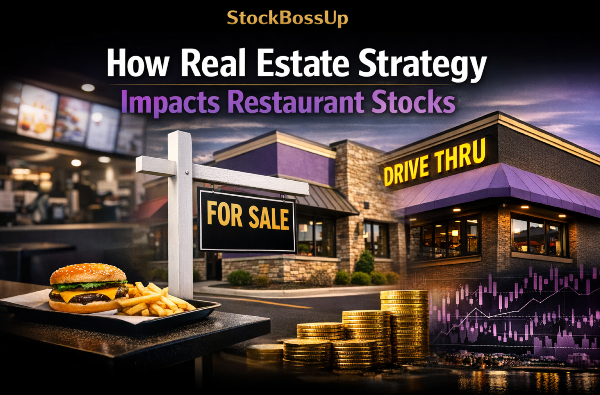
🔑 Key Takeaways: How Real Estate Strategy Impacts Restaurant Stock Valuations
🏗️ Real estate control drives long‑term valuation strength
Restaurant chains that **own** their land build equity and stability, while those that **lease** gain flexibility but face recurring rent pressure. Ownership often earns higher valuation multiples because investors trust predictable earnings and asset growth.
📍 Location type quietly shapes investor confidence
Drive‑thru, corner, and highway‑exit sites outperform mall or mid‑block locations. These real estate choices influence traffic flow, daily sales, and ultimately how investors perceive a brand’s growth potential.
💰 Hybrid models balance speed and stability
Chains mixing owned and leased properties achieve both expansion agility and cost control. This balance often results in stronger cash flow and lower risk—key factors that support sustained stock performance.
🏠 Real estate appreciation can outpace food sales
In certain years, some restaurant companies earn more from **property value increases** than from menu sales. This hidden profit source explains why two brands with similar revenue can have vastly different stock valuations.
Real estate decisions shape the long‑term value of every restaurant chain. Yet many investors overlook how site choices, lease terms, and land ownership quietly change the way a stock behaves. The problem shows up when two companies report similar sales growth, but only one sees its stock rise. The other stalls, even though the numbers look almost the same. Something in the background is pulling the valuation in opposite directions. The answer becomes clear only after you understand how real estate strategy works inside the restaurant business. That clarity comes later in this article, after we explore the forces that make real estate one of the most powerful drivers of stock performance.
Why Do Some Restaurant Stocks Rise Faster Even With Similar Sales?
Two restaurant chains can open the same number of stores and report the same revenue growth. Yet one stock climbs while the other barely moves. Investors often assume the difference comes from brand strength or menu innovation. Those matter, but they are not the full story. Real estate strategy creates hidden advantages that shape how fast a company can grow and how much profit it keeps.
A chain that owns its land builds equity over time. A chain that leases everything stays flexible but carries long‑term rent obligations. Both paths can work, but they produce very different financial outcomes. These outcomes show up in valuation ratios, cash flow, and investor confidence.
One unique fact many investors miss is that some restaurant chains earn more from real estate appreciation than from food sales during certain years. Another lesser‑known fact is that a few chains design their store layouts based on satellite heat‑mapping of traffic patterns, not just demographic data. These choices influence how well a stock performs over long periods.
How Does Land Ownership Change a Restaurant’s Financial Strength?
Owning land gives a restaurant chain a strong balance sheet. The property becomes an asset that grows in value. This helps the company borrow at lower rates, expand faster, and survive downturns. When a chain owns a large share of its sites, investors often view it as more stable.
Ownership also reduces rent pressure. Rent increases can eat into margins, especially in high‑traffic areas. A company that owns its land avoids these rising costs. This stability often leads to higher valuation multiples because investors trust the earnings more.
Leasing, on the other hand, keeps upfront costs low. A chain can expand quickly without tying up capital. But the long‑term rent obligations reduce flexibility. If sales fall, the company still owes the same rent. This risk can lower the stock’s valuation.
Where Does Leasing Offer Advantages That Ownership Cannot?
Leasing gives restaurants speed. A chain can test new markets without committing to long‑term property ownership. If a location underperforms, the company can exit more easily. This agility helps fast‑growing brands scale quickly.
Leasing also allows companies to focus capital on marketing, technology, or menu development. These areas can drive short‑term sales growth, which investors often reward. A company with a strong leasing strategy can show rapid expansion and rising revenue, even if it does not build long‑term equity.
Still, leasing comes with trade‑offs. Rent escalators, renewal risks, and landlord negotiations can create uncertainty. Investors watch these factors closely because they affect future earnings.
Why Do Some Chains Choose Hybrid Real Estate Models?
Many restaurant companies use a mix of owned and leased properties. This hybrid model balances stability and flexibility. Chains often own flagship locations in high‑value areas while leasing stores in smaller markets.
Owning key sites protects the company from rent spikes. Leasing secondary sites keeps expansion costs low. This blend can create a strong financial profile that appeals to investors.
The hybrid model also helps companies manage risk. If a leased location fails, the company can exit. If an owned location succeeds, the company gains both sales and property appreciation.
How Do Real Estate Choices Affect Cash Flow and Valuation?
Cash flow is one of the most important factors in restaurant stock valuation. Real estate strategy shapes cash flow in several ways:
- Owned properties reduce rent expenses
- Leased properties increase operating costs
- Owned properties require more upfront capital
- Leased properties free up cash for growth
Investors look at free cash flow to judge how well a company can expand, pay dividends, or buy back shares. Real estate decisions directly influence this number.
Below is a simple comparison of how ownership vs. leasing affects financial outcomes:
| Strategy |
Upfront Cost |
Long‑Term Cost |
Flexibility |
Impact on Valuation |
| Ownership |
High |
Low |
Medium |
Often Higher |
| Leasing |
Low |
High |
High |
Mixed |
| Hybrid |
Medium |
Medium |
High |
Often Strong |
Why Do Location Types Matter More Than Most Investors Realize?
Not all restaurant locations are equal. A drive‑thru site behaves differently from a mall food court. A suburban pad site behaves differently from an urban storefront. Real estate strategy must match the brand’s business model.
Drive‑thru locations often require more land but generate higher sales per unit. Urban storefronts cost more but offer strong foot traffic. Mall locations depend on the health of the mall itself.
Investors who understand these differences can better predict which chains will grow and which may struggle. A company expanding into the wrong location type can see its stock stall even if sales look stable.
How Do Franchise Models Change Real Estate Decisions?
Franchise-heavy chains often avoid owning real estate. Franchisees take on the cost of land and buildings. This reduces the company’s capital needs and increases its return on invested capital.
But franchise models also limit control. If franchisees choose poor locations, the brand suffers. Investors watch franchise real estate decisions closely because they affect long‑term brand strength.
Company-owned models give full control over site selection. This can lead to better long‑term outcomes but requires more capital.
Why Do Some Restaurant Chains Focus on Corner Lots and Traffic Patterns?
Corner lots offer better visibility and easier access. These factors increase sales. Many chains pay a premium for corner locations because the long‑term payoff is worth it.
Traffic patterns also matter. Restaurants want to be on the “going‑home” side of the road during evening hours. This small detail can change daily sales by a large margin.
Below is a breakdown of how location features affect performance:
| Location Feature |
Impact on Sales |
Impact on Costs |
Investor View |
| Corner Lot |
High |
High |
Positive |
| Mid‑Block |
Medium |
Medium |
Neutral |
| Highway Exit |
High |
Medium |
Positive |
| Mall Interior |
Low |
Low |
Mixed |
How Do Real Estate Costs Shape Expansion Speed?
Expansion speed depends on how much capital a company can deploy. Ownership slows expansion because each site requires a large investment. Leasing speeds expansion because the upfront cost is lower.
Investors often reward fast expansion. But they also punish companies that expand too quickly without strong real estate discipline. Poor site selection can lead to store closures, which hurt valuation.
A balanced approach helps companies grow at a steady pace without taking on too much risk.
Why Do Some Markets Produce Higher Stock Multiples?
Real estate markets vary widely. A restaurant chain with many stores in high‑growth cities often earns a higher valuation. These markets offer rising property values, strong demographics, and stable demand.
Chains in slow‑growth or declining markets may struggle. Even if sales are steady, the lack of real estate appreciation can hold back the stock.
Investors look at geographic mix to judge long‑term potential. A chain with strong locations in growing regions often commands a premium.
How Do Sale‑Leaseback Deals Affect Restaurant Stocks?
Sale‑leaseback deals allow companies to sell owned properties and lease them back. This frees up cash for expansion or debt reduction. But it also increases long‑term rent obligations.
Investors view sale‑leasebacks in different ways. Some see them as smart capital management. Others see them as short‑term gains that reduce long‑term stability.
The impact depends on how the company uses the cash. If it funds high‑return projects, the stock may rise. If it covers short‑term problems, the stock may fall.
Why Do Real Estate Strategies Matter More During Economic Downturns?
During downturns, rent becomes a heavy burden. Chains with high lease exposure face more pressure. Chains that own their land have more stability.
Investors often shift toward companies with strong real estate positions during recessions. These companies can weather slowdowns better and recover faster.
Real estate strategy becomes a key factor in valuation during tough times.
How Does Real Estate Strategy Shape Long‑Term Stock Performance?
Over long periods, real estate decisions compound. Owned properties appreciate. Leased properties accumulate rent obligations. Hybrid models balance both.
Investors who understand these patterns can better predict which stocks will grow steadily. Real estate strategy explains why some chains outperform even when sales growth looks similar.
Below is a long‑term comparison of how strategies influence performance:
| Strategy |
Long‑Term Stability |
Growth Potential |
Risk Level |
| Ownership |
High |
Medium |
Low |
| Leasing |
Medium |
High |
Medium |
| Hybrid |
High |
High |
Low |
What Is the Hidden Real Estate Factor That Explains Valuation Gaps?
The hidden factor is control. Real estate strategy determines how much control a restaurant chain has over its future. Ownership gives control over costs. Leasing gives control over speed. Hybrid models give control over both.
When investors sense strong control, they reward the stock with higher valuation multiples. When control is weak, the stock struggles even if sales look good.
This is why two companies with similar numbers can have very different stock prices. Real estate strategy shapes the path of the business, and investors follow that path closely.
What Is the Real Reason Real Estate Strategy Drives Valuation?
The real reason is that real estate decisions shape every part of the business. They influence costs, growth, risk, and long‑term value. They determine how much flexibility a company has and how much stability it can maintain.
The problem introduced at the start—two companies with similar sales but different stock performance—comes down to real estate strategy. The company with stronger control over its sites, costs, and expansion path earns a higher valuation. The company without that control struggles to convince investors of its long‑term potential.
Real estate is not just a background detail. It is one of the most powerful forces shaping restaurant stock valuations.
🏗️ Master the Terrain: Prime Restaurant Real Estate Insights
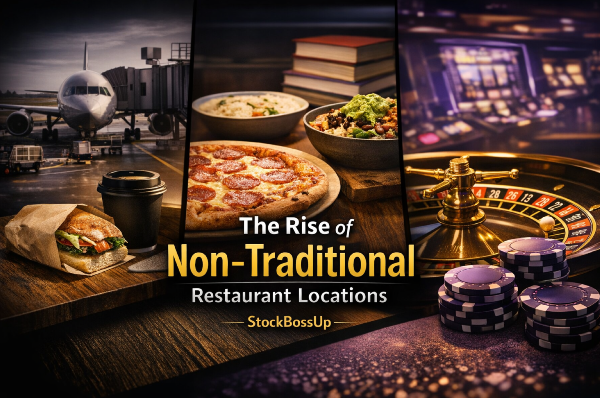
Unlock the hidden value in your portfolio by mastering the "where" and "how" of restaurant expansion. From high-traffic non-traditional sites to the algorithmic precision of modern site selection, explore how physical footprints dictate fiscal futures.
📍 Strategic Growth & Real Estate in Restaurant Businesses
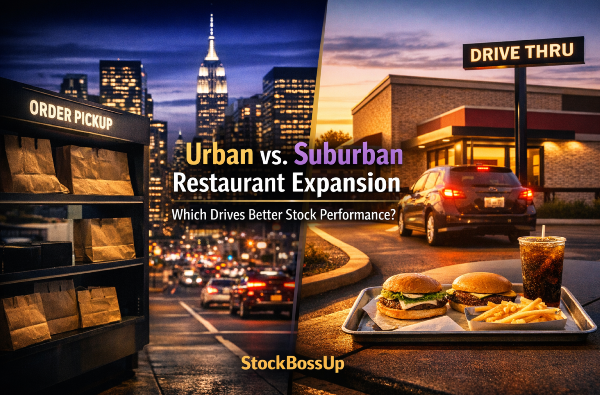
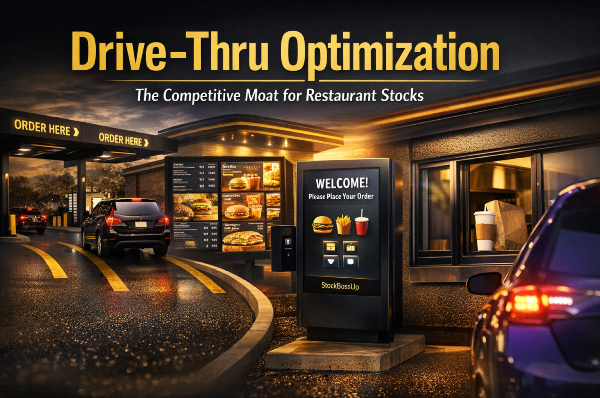
Market Intel: In an era of shifting demographics, the transition from urban centers to optimized suburban drive-thrus is redefining long-term equity. Use the links above to deep dive into the data driving these shifts.







🔑 Key Takeaways: How Real Estate Strategy Impacts Restaurant Stock Valuations
🏗️ Real estate control drives long‑term valuation strength
Restaurant chains that **own** their land build equity and stability, while those that **lease** gain flexibility but face recurring rent pressure. Ownership often earns higher valuation multiples because investors trust predictable earnings and asset growth.📍 Location type quietly shapes investor confidence
Drive‑thru, corner, and highway‑exit sites outperform mall or mid‑block locations. These real estate choices influence traffic flow, daily sales, and ultimately how investors perceive a brand’s growth potential.💰 Hybrid models balance speed and stability
Chains mixing owned and leased properties achieve both expansion agility and cost control. This balance often results in stronger cash flow and lower risk—key factors that support sustained stock performance.🏠 Real estate appreciation can outpace food sales
In certain years, some restaurant companies earn more from **property value increases** than from menu sales. This hidden profit source explains why two brands with similar revenue can have vastly different stock valuations.Real estate decisions shape the long‑term value of every restaurant chain. Yet many investors overlook how site choices, lease terms, and land ownership quietly change the way a stock behaves. The problem shows up when two companies report similar sales growth, but only one sees its stock rise. The other stalls, even though the numbers look almost the same. Something in the background is pulling the valuation in opposite directions. The answer becomes clear only after you understand how real estate strategy works inside the restaurant business. That clarity comes later in this article, after we explore the forces that make real estate one of the most powerful drivers of stock performance.
Why Do Some Restaurant Stocks Rise Faster Even With Similar Sales?
Two restaurant chains can open the same number of stores and report the same revenue growth. Yet one stock climbs while the other barely moves. Investors often assume the difference comes from brand strength or menu innovation. Those matter, but they are not the full story. Real estate strategy creates hidden advantages that shape how fast a company can grow and how much profit it keeps.
A chain that owns its land builds equity over time. A chain that leases everything stays flexible but carries long‑term rent obligations. Both paths can work, but they produce very different financial outcomes. These outcomes show up in valuation ratios, cash flow, and investor confidence.
One unique fact many investors miss is that some restaurant chains earn more from real estate appreciation than from food sales during certain years. Another lesser‑known fact is that a few chains design their store layouts based on satellite heat‑mapping of traffic patterns, not just demographic data. These choices influence how well a stock performs over long periods.
How Does Land Ownership Change a Restaurant’s Financial Strength?
Owning land gives a restaurant chain a strong balance sheet. The property becomes an asset that grows in value. This helps the company borrow at lower rates, expand faster, and survive downturns. When a chain owns a large share of its sites, investors often view it as more stable.
Ownership also reduces rent pressure. Rent increases can eat into margins, especially in high‑traffic areas. A company that owns its land avoids these rising costs. This stability often leads to higher valuation multiples because investors trust the earnings more.
Leasing, on the other hand, keeps upfront costs low. A chain can expand quickly without tying up capital. But the long‑term rent obligations reduce flexibility. If sales fall, the company still owes the same rent. This risk can lower the stock’s valuation.
Where Does Leasing Offer Advantages That Ownership Cannot?
Leasing gives restaurants speed. A chain can test new markets without committing to long‑term property ownership. If a location underperforms, the company can exit more easily. This agility helps fast‑growing brands scale quickly.
Leasing also allows companies to focus capital on marketing, technology, or menu development. These areas can drive short‑term sales growth, which investors often reward. A company with a strong leasing strategy can show rapid expansion and rising revenue, even if it does not build long‑term equity.
Still, leasing comes with trade‑offs. Rent escalators, renewal risks, and landlord negotiations can create uncertainty. Investors watch these factors closely because they affect future earnings.
Why Do Some Chains Choose Hybrid Real Estate Models?
Many restaurant companies use a mix of owned and leased properties. This hybrid model balances stability and flexibility. Chains often own flagship locations in high‑value areas while leasing stores in smaller markets.
Owning key sites protects the company from rent spikes. Leasing secondary sites keeps expansion costs low. This blend can create a strong financial profile that appeals to investors.
The hybrid model also helps companies manage risk. If a leased location fails, the company can exit. If an owned location succeeds, the company gains both sales and property appreciation.
How Do Real Estate Choices Affect Cash Flow and Valuation?
Cash flow is one of the most important factors in restaurant stock valuation. Real estate strategy shapes cash flow in several ways:
Investors look at free cash flow to judge how well a company can expand, pay dividends, or buy back shares. Real estate decisions directly influence this number.
Below is a simple comparison of how ownership vs. leasing affects financial outcomes:
Why Do Location Types Matter More Than Most Investors Realize?
Not all restaurant locations are equal. A drive‑thru site behaves differently from a mall food court. A suburban pad site behaves differently from an urban storefront. Real estate strategy must match the brand’s business model.
Drive‑thru locations often require more land but generate higher sales per unit. Urban storefronts cost more but offer strong foot traffic. Mall locations depend on the health of the mall itself.
Investors who understand these differences can better predict which chains will grow and which may struggle. A company expanding into the wrong location type can see its stock stall even if sales look stable.
How Do Franchise Models Change Real Estate Decisions?
Franchise-heavy chains often avoid owning real estate. Franchisees take on the cost of land and buildings. This reduces the company’s capital needs and increases its return on invested capital.
But franchise models also limit control. If franchisees choose poor locations, the brand suffers. Investors watch franchise real estate decisions closely because they affect long‑term brand strength.
Company-owned models give full control over site selection. This can lead to better long‑term outcomes but requires more capital.
Why Do Some Restaurant Chains Focus on Corner Lots and Traffic Patterns?
Corner lots offer better visibility and easier access. These factors increase sales. Many chains pay a premium for corner locations because the long‑term payoff is worth it.
Traffic patterns also matter. Restaurants want to be on the “going‑home” side of the road during evening hours. This small detail can change daily sales by a large margin.
Below is a breakdown of how location features affect performance:
How Do Real Estate Costs Shape Expansion Speed?
Expansion speed depends on how much capital a company can deploy. Ownership slows expansion because each site requires a large investment. Leasing speeds expansion because the upfront cost is lower.
Investors often reward fast expansion. But they also punish companies that expand too quickly without strong real estate discipline. Poor site selection can lead to store closures, which hurt valuation.
A balanced approach helps companies grow at a steady pace without taking on too much risk.
Why Do Some Markets Produce Higher Stock Multiples?
Real estate markets vary widely. A restaurant chain with many stores in high‑growth cities often earns a higher valuation. These markets offer rising property values, strong demographics, and stable demand.
Chains in slow‑growth or declining markets may struggle. Even if sales are steady, the lack of real estate appreciation can hold back the stock.
Investors look at geographic mix to judge long‑term potential. A chain with strong locations in growing regions often commands a premium.
How Do Sale‑Leaseback Deals Affect Restaurant Stocks?
Sale‑leaseback deals allow companies to sell owned properties and lease them back. This frees up cash for expansion or debt reduction. But it also increases long‑term rent obligations.
Investors view sale‑leasebacks in different ways. Some see them as smart capital management. Others see them as short‑term gains that reduce long‑term stability.
The impact depends on how the company uses the cash. If it funds high‑return projects, the stock may rise. If it covers short‑term problems, the stock may fall.
Why Do Real Estate Strategies Matter More During Economic Downturns?
During downturns, rent becomes a heavy burden. Chains with high lease exposure face more pressure. Chains that own their land have more stability.
Investors often shift toward companies with strong real estate positions during recessions. These companies can weather slowdowns better and recover faster.
Real estate strategy becomes a key factor in valuation during tough times.
How Does Real Estate Strategy Shape Long‑Term Stock Performance?
Over long periods, real estate decisions compound. Owned properties appreciate. Leased properties accumulate rent obligations. Hybrid models balance both.
Investors who understand these patterns can better predict which stocks will grow steadily. Real estate strategy explains why some chains outperform even when sales growth looks similar.
Below is a long‑term comparison of how strategies influence performance:
What Is the Hidden Real Estate Factor That Explains Valuation Gaps?
The hidden factor is control. Real estate strategy determines how much control a restaurant chain has over its future. Ownership gives control over costs. Leasing gives control over speed. Hybrid models give control over both.
When investors sense strong control, they reward the stock with higher valuation multiples. When control is weak, the stock struggles even if sales look good.
This is why two companies with similar numbers can have very different stock prices. Real estate strategy shapes the path of the business, and investors follow that path closely.
What Is the Real Reason Real Estate Strategy Drives Valuation?
The real reason is that real estate decisions shape every part of the business. They influence costs, growth, risk, and long‑term value. They determine how much flexibility a company has and how much stability it can maintain.
The problem introduced at the start—two companies with similar sales but different stock performance—comes down to real estate strategy. The company with stronger control over its sites, costs, and expansion path earns a higher valuation. The company without that control struggles to convince investors of its long‑term potential.
Real estate is not just a background detail. It is one of the most powerful forces shaping restaurant stock valuations.
🏗️ Master the Terrain: Prime Restaurant Real Estate Insights
Unlock the hidden value in your portfolio by mastering the "where" and "how" of restaurant expansion. From high-traffic non-traditional sites to the algorithmic precision of modern site selection, explore how physical footprints dictate fiscal futures.
📍 Strategic Growth & Real Estate in Restaurant Businesses