🔑 Key Takeaways: How Commodity Prices Affect Auto Manufacturing Costs
🏗️ Commodity prices directly shape the cost of building vehicles and influence profit margins
Auto manufacturers rely heavily on materials like steel, aluminum, copper, and rubber. When commodity prices rise or fall, production costs shift quickly, impacting profitability and sometimes leading to changes in vehicle pricing.
🔋 Electric vehicles increase exposure to volatile commodity markets, especially battery metals
EV production depends on lithium, nickel, and cobalt, which are highly sensitive to global supply and demand. This makes electric vehicles more exposed to commodity price swings than traditional gas-powered cars.
🌍 Global supply chains and energy costs amplify commodity price volatility across the auto industry
Because raw materials are sourced and processed worldwide, disruptions in energy markets, logistics, or mining can quickly ripple through the entire supply chain and increase manufacturing costs.
📉 Automakers use contracts, recycling, and diversification strategies to reduce commodity price risk
To manage uncertainty, companies rely on long-term supplier agreements, material recycling programs, and alternative sourcing strategies. These methods help stabilize costs but cannot fully eliminate global commodity risk.
How Commodity Prices Affect Auto Manufacturing Costs
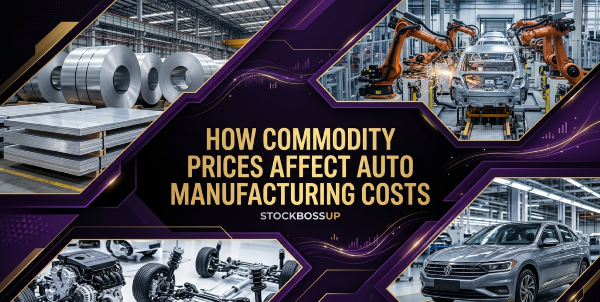
Auto manufacturing depends heavily on raw materials. Every vehicle is built using steel, aluminum, rubber, plastics, copper, and rare metals. These materials are traded globally, and their prices change constantly.
The problem is not just cost. It is volatility. Commodity prices can shift quickly based on supply shortages, global demand, energy costs, and geopolitical events. When this happens, automakers must adjust production budgets, pricing strategies, and supply chain planning.
Many investors and consumers do not realize how sensitive car prices are to raw material markets. A small change in steel or lithium prices can affect millions of vehicles worldwide.
The real question is how commodity price changes ripple through the auto industry and what companies do to manage that risk.
Why Are Commodities So Important in Auto Manufacturing?
Commodities are the foundation of vehicle production. Without them, cars cannot be built.
Each vehicle contains hundreds of kilograms of raw materials. These materials are used in:
- Body frames
- Engines
- Batteries
- Wiring systems
- Interior components
Because of this, even small price changes can scale into large financial impacts.
A lesser-known fact is that steel alone can account for up to 15% of the total material cost of a traditional vehicle.
Why Do Steel Prices Matter So Much?
Steel is one of the most important materials in auto manufacturing. It is used for the body structure, safety reinforcement, and chassis.
When steel prices rise, production costs increase almost immediately.
Automakers often have long-term contracts with suppliers, but those contracts eventually adjust to market prices.
| Commodity Type |
Vehicle Use Case |
Price Sensitivity |
Cost Impact Level |
| Steel |
Body structure |
High |
Very High |
| Aluminum |
Lightweight panels |
High |
High |
| Copper |
Wiring systems |
Medium |
Medium |
| Rubber |
Tires and seals |
Medium |
Medium |
Why Are Battery Metals Changing the Industry?
Electric vehicles rely heavily on battery materials such as lithium, nickel, and cobalt.
These materials are more volatile than traditional auto commodities.
Their prices can change quickly based on mining output, geopolitical tensions, and demand spikes from EV adoption.
This makes EV production more sensitive to commodity markets than traditional vehicles.
A surprising detail is that lithium prices have, at times, increased more than fivefold within a single year due to rapid EV demand growth.
Why Do Commodity Prices Fluctuate So Frequently?
Commodity prices fluctuate due to several global factors.
These include:
- Supply chain disruptions
- Energy costs
- Natural disasters
- Trade restrictions
- Global demand shifts
Because commodities are traded globally, even small disruptions can affect prices worldwide.
| Price Driver |
Effect on Commodities |
Industry Impact |
| Supply shortages |
Price increase |
Higher costs |
| High demand |
Price increase |
Tight supply |
| Economic slowdown |
Price decrease |
Lower costs |
| Geopolitical events |
High volatility |
Uncertainty |
Why Do Automakers Struggle With Cost Predictability?
Automakers struggle with cost predictability because commodity prices are outside their control.
Even if production is efficient, rising material costs can reduce profit margins.
This creates uncertainty in financial planning.
Companies must constantly update forecasts based on market conditions.
Why Are Aluminum Costs Increasing in Importance?
Aluminum is becoming more important because automakers are trying to reduce vehicle weight.
Lighter vehicles improve fuel efficiency and battery range.
However, aluminum is more expensive than steel and more sensitive to energy costs.
Producing aluminum requires large amounts of electricity, which ties its price to global energy markets.
| Material |
Weight Efficiency |
Cost Level |
Energy Dependency |
| Steel |
Low |
Low |
Medium |
| Aluminum |
High |
High |
High |
| Carbon fiber |
Very high |
Very high |
Medium |
Why Are Energy Prices Linked to Auto Manufacturing Costs?
Energy prices affect almost every stage of auto production.
Factories use electricity, transportation systems rely on fuel, and raw materials often require energy-intensive processing.
When energy prices rise, commodity prices often follow.
A unique trend is that some aluminum smelting operations consume as much electricity as small cities, making them highly sensitive to energy price changes.
Why Do Supply Chains Amplify Commodity Risk?
Global supply chains increase exposure to commodity price changes.
Parts are produced in multiple countries before final assembly.
Each stage adds cost variability depending on local commodity prices.
This makes the final vehicle cost harder to stabilize.
| Supply Chain Stage |
Commodity Exposure |
Risk Level |
| Raw material mining |
High |
High |
| Component manufacturing |
Medium–High |
Medium |
| Assembly plants |
Medium |
Medium |
| Distribution |
Low |
Low |
Why Do EVs Have Higher Commodity Sensitivity?
Electric vehicles are more sensitive to commodity prices because of their battery systems.
Batteries require large amounts of lithium, nickel, and cobalt.
These materials are more volatile than traditional automotive inputs.
This increases cost uncertainty for EV manufacturers.
Why Do Automakers Use Long-Term Contracts?
Automakers use long-term contracts to stabilize commodity costs.
These contracts lock in prices for extended periods.
This reduces short-term volatility but can limit flexibility if market prices fall.
Companies must balance stability with cost optimization.
Why Do Commodity Prices Affect Car Prices?
Commodity prices directly influence the final cost of vehicles.
If raw material costs increase, automakers often pass some of that cost to consumers.
However, competitive pressure limits how much can be passed through.
This creates margin pressure for manufacturers.
| Cost Change Scenario |
Manufacturer Response |
Consumer Impact |
| Rising commodity costs |
Partial price increase |
Higher car prices |
| Stable costs |
Stable pricing |
No change |
| Falling costs |
Discount opportunities |
Lower prices |
Why Are Rare Earth Metals Becoming More Important?
Rare earth metals are used in electric motors, sensors, and advanced electronics.
As vehicles become more digital and electric, demand for these materials increases.
This creates new supply chain risks.
A surprising detail is that most rare earth processing is concentrated in a small number of countries, which increases global supply vulnerability.
Why Do Commodity Cycles Affect Auto Stocks?
Commodity cycles have a direct impact on auto manufacturer stock performance.
When material costs rise, profit margins shrink, which can lower stock prices.
When commodity prices fall, margins expand, often boosting investor confidence.
Investors closely track commodity markets as leading indicators for auto sector performance.
Why Are Sustainable Materials Changing the Industry?
Automakers are exploring recycled and alternative materials to reduce commodity risk.
This includes:
- Recycled steel
- Bio-based plastics
- Recovered aluminum
- Battery recycling systems
These strategies help reduce dependency on volatile commodity markets.
What Is the Real Long-Term Impact of Commodity Prices on Auto Manufacturing?
Commodity prices will remain a core driver of auto manufacturing costs.
They influence everything from design decisions to pricing strategies and stock performance.
The solution is not eliminating commodity exposure. It is managing it through diversification, recycling, long-term contracts, and supply chain flexibility.
In the end, commodity prices act as a hidden force behind every vehicle on the road. They shape costs, influence innovation, and determine how competitive automakers can be in a global market.



















🔑 Key Takeaways: How Commodity Prices Affect Auto Manufacturing Costs
🏗️ Commodity prices directly shape the cost of building vehicles and influence profit margins
Auto manufacturers rely heavily on materials like steel, aluminum, copper, and rubber. When commodity prices rise or fall, production costs shift quickly, impacting profitability and sometimes leading to changes in vehicle pricing.
🔋 Electric vehicles increase exposure to volatile commodity markets, especially battery metals
EV production depends on lithium, nickel, and cobalt, which are highly sensitive to global supply and demand. This makes electric vehicles more exposed to commodity price swings than traditional gas-powered cars.
🌍 Global supply chains and energy costs amplify commodity price volatility across the auto industry
Because raw materials are sourced and processed worldwide, disruptions in energy markets, logistics, or mining can quickly ripple through the entire supply chain and increase manufacturing costs.
📉 Automakers use contracts, recycling, and diversification strategies to reduce commodity price risk
To manage uncertainty, companies rely on long-term supplier agreements, material recycling programs, and alternative sourcing strategies. These methods help stabilize costs but cannot fully eliminate global commodity risk.
How Commodity Prices Affect Auto Manufacturing Costs
Auto manufacturing depends heavily on raw materials. Every vehicle is built using steel, aluminum, rubber, plastics, copper, and rare metals. These materials are traded globally, and their prices change constantly.
The problem is not just cost. It is volatility. Commodity prices can shift quickly based on supply shortages, global demand, energy costs, and geopolitical events. When this happens, automakers must adjust production budgets, pricing strategies, and supply chain planning.
Many investors and consumers do not realize how sensitive car prices are to raw material markets. A small change in steel or lithium prices can affect millions of vehicles worldwide.
The real question is how commodity price changes ripple through the auto industry and what companies do to manage that risk.
Why Are Commodities So Important in Auto Manufacturing?
Commodities are the foundation of vehicle production. Without them, cars cannot be built.
Each vehicle contains hundreds of kilograms of raw materials. These materials are used in:
Because of this, even small price changes can scale into large financial impacts.
A lesser-known fact is that steel alone can account for up to 15% of the total material cost of a traditional vehicle.
Why Do Steel Prices Matter So Much?
Steel is one of the most important materials in auto manufacturing. It is used for the body structure, safety reinforcement, and chassis.
When steel prices rise, production costs increase almost immediately.
Automakers often have long-term contracts with suppliers, but those contracts eventually adjust to market prices.
Why Are Battery Metals Changing the Industry?
Electric vehicles rely heavily on battery materials such as lithium, nickel, and cobalt.
These materials are more volatile than traditional auto commodities.
Their prices can change quickly based on mining output, geopolitical tensions, and demand spikes from EV adoption.
This makes EV production more sensitive to commodity markets than traditional vehicles.
A surprising detail is that lithium prices have, at times, increased more than fivefold within a single year due to rapid EV demand growth.
Why Do Commodity Prices Fluctuate So Frequently?
Commodity prices fluctuate due to several global factors.
These include:
Because commodities are traded globally, even small disruptions can affect prices worldwide.
Why Do Automakers Struggle With Cost Predictability?
Automakers struggle with cost predictability because commodity prices are outside their control.
Even if production is efficient, rising material costs can reduce profit margins.
This creates uncertainty in financial planning.
Companies must constantly update forecasts based on market conditions.
Why Are Aluminum Costs Increasing in Importance?
Aluminum is becoming more important because automakers are trying to reduce vehicle weight.
Lighter vehicles improve fuel efficiency and battery range.
However, aluminum is more expensive than steel and more sensitive to energy costs.
Producing aluminum requires large amounts of electricity, which ties its price to global energy markets.
Why Are Energy Prices Linked to Auto Manufacturing Costs?
Energy prices affect almost every stage of auto production.
Factories use electricity, transportation systems rely on fuel, and raw materials often require energy-intensive processing.
When energy prices rise, commodity prices often follow.
A unique trend is that some aluminum smelting operations consume as much electricity as small cities, making them highly sensitive to energy price changes.
Why Do Supply Chains Amplify Commodity Risk?
Global supply chains increase exposure to commodity price changes.
Parts are produced in multiple countries before final assembly.
Each stage adds cost variability depending on local commodity prices.
This makes the final vehicle cost harder to stabilize.
Why Do EVs Have Higher Commodity Sensitivity?
Electric vehicles are more sensitive to commodity prices because of their battery systems.
Batteries require large amounts of lithium, nickel, and cobalt.
These materials are more volatile than traditional automotive inputs.
This increases cost uncertainty for EV manufacturers.
Why Do Automakers Use Long-Term Contracts?
Automakers use long-term contracts to stabilize commodity costs.
These contracts lock in prices for extended periods.
This reduces short-term volatility but can limit flexibility if market prices fall.
Companies must balance stability with cost optimization.
Why Do Commodity Prices Affect Car Prices?
Commodity prices directly influence the final cost of vehicles.
If raw material costs increase, automakers often pass some of that cost to consumers.
However, competitive pressure limits how much can be passed through.
This creates margin pressure for manufacturers.
Why Are Rare Earth Metals Becoming More Important?
Rare earth metals are used in electric motors, sensors, and advanced electronics.
As vehicles become more digital and electric, demand for these materials increases.
This creates new supply chain risks.
A surprising detail is that most rare earth processing is concentrated in a small number of countries, which increases global supply vulnerability.
Why Do Commodity Cycles Affect Auto Stocks?
Commodity cycles have a direct impact on auto manufacturer stock performance.
When material costs rise, profit margins shrink, which can lower stock prices.
When commodity prices fall, margins expand, often boosting investor confidence.
Investors closely track commodity markets as leading indicators for auto sector performance.
Why Are Sustainable Materials Changing the Industry?
Automakers are exploring recycled and alternative materials to reduce commodity risk.
This includes:
These strategies help reduce dependency on volatile commodity markets.
What Is the Real Long-Term Impact of Commodity Prices on Auto Manufacturing?
Commodity prices will remain a core driver of auto manufacturing costs.
They influence everything from design decisions to pricing strategies and stock performance.
The solution is not eliminating commodity exposure. It is managing it through diversification, recycling, long-term contracts, and supply chain flexibility.
In the end, commodity prices act as a hidden force behind every vehicle on the road. They shape costs, influence innovation, and determine how competitive automakers can be in a global market.