🔑 Key Takeaways: U.S. vs European Auto Manufacturers
🚗 U.S. automakers prioritize scale, trucks, and lower ownership costs
U.S. brands like Ford (F) and General Motors (GM) are built around large-scale production, pickup trucks, and SUVs. Their strength is affordability, durability, and lower maintenance costs. This makes them ideal for utility-driven drivers and cost-conscious long-term ownership.
🏎️ European automakers focus on luxury, precision engineering, and driving experience
European brands like BMW Group (BMWYY), Mercedes-Benz Group (MBGYY), and Volkswagen Group (VOW) emphasize refined engineering, performance handling, and premium interiors. Their vehicles are designed for driving experience and brand prestige rather than mass utility.
📊 Auto stocks reflect two different investment styles: cyclical vs global luxury exposure
U.S. auto stocks tend to follow domestic demand cycles driven by trucks and interest rates. European auto stocks are more exposed to global luxury demand, currency fluctuations, and export markets. This creates different risk and growth profiles for investors.
⚖️ The real difference is trade-off: utility and cost vs refinement and complexity
The gap between U.S. and European automakers is less about quality and more about priorities. U.S. vehicles optimize for practicality and affordability, while European vehicles prioritize performance, luxury, and engineering depth—even if that increases long-term maintenance complexity.
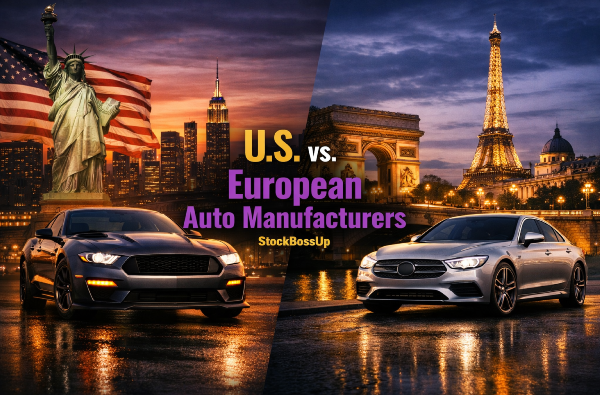
U.S. vs European Auto Manufacturers
At first glance, comparing U.S. and European automakers seems simple. American brands focus on trucks, power, and scale. European brands focus on luxury, engineering, and refinement.
But this simple view hides a deeper problem.
Most buyers and investors think they understand what they are paying for—power vs luxury, or size vs precision. Yet the real differences show up later in ownership costs, maintenance complexity, and even stock performance over time.
Many people only realize the trade-offs after years of payments, repairs, or portfolio underperformance.
So what actually separates U.S. and European automakers in a way that matters long after the purchase is made?
The answer is not obvious at the beginning—but it becomes clear when you break down how each region builds, prices, and scales its vehicles.
Why Do U.S. and European Automakers Compete So Differently?
The U.S. and Europe built their automotive industries around different needs.
The United States focused on:
- Large geography
- Long-distance driving
- Truck and SUV demand
- Mass production scale
Europe focused on:
- Dense cities
- Fuel efficiency regulations
- Engineering precision
- Premium brand heritage
Major U.S. automakers:
- Ford Motor Company (F)
- General Motors (GM)
- Stellantis (STLA)
Major European automakers:
- Volkswagen Group (VWAGY)
- BMW Group (BMWYY)
- Mercedes-Benz Group (MBGYY)
- Renault Group (RNSDF)
These companies reflect two different philosophies:
- U.S.: scale and utility
- Europe: precision and refinement
Why Do American Automakers Focus on Scale and Utility?
U.S. automakers are built around one core idea: scale.
Ford (F) and General Motors (GM) design vehicles for large, diverse markets with heavy demand for trucks and SUVs.
This leads to a focus on:
- High towing capacity
- Large vehicles
- Mass production efficiency
- Lower cost manufacturing
A key strength is the dominance of pickup trucks, especially in North America. These vehicles generate high profit margins and strong brand loyalty.
One historical insight is that Ford’s early assembly line system reshaped global manufacturing, and many modern production systems still reflect that model today.
Why Do European Automakers Focus on Engineering and Brand Identity?
European automakers prioritize engineering depth and brand prestige.
BMW Group (BMWYY) emphasizes driving performance. Mercedes-Benz Group (MBGYY) focuses on luxury and advanced comfort systems. Volkswagen Group (VWAGY) balances mass-market cars with premium brands like Audi and Porsche.
A unique historical factor is that Germany’s Autobahn system helped shape high-speed vehicle engineering standards, pushing manufacturers to optimize stability at higher speeds.
European automakers tend to focus on:
- Driving refinement
- Interior luxury
- Fuel efficiency
- Strong brand hierarchy
How Do U.S. and European Auto Stocks Compare?
| Region |
Key Stocks |
Volatility |
Revenue Drivers |
Investment Style |
| U.S. |
F, GM, STLA |
Moderate |
Trucks, SUVs |
Cyclical growth |
| Europe |
VWAGY, BMWYY, MBGYY, RNSDF |
Moderate to high |
Luxury + exports |
Mixed value & growth |
U.S. stocks tend to move with domestic demand cycles. European stocks are more exposed to global luxury demand and currency shifts.
Why Are Trucks So Important to U.S. Automakers?
Trucks are the backbone of U.S. automaker profitability.
Ford (F) and General Motors (GM) rely heavily on pickup sales due to:
- Higher margins
- Strong brand loyalty
- Long replacement cycles
- Work-related demand
This creates a structural advantage unique to the U.S. market.
Why Do European Automakers Dominate Luxury Markets?
European automakers dominate global luxury perception.
BMW Group (BMWYY) and Mercedes-Benz Group (MBGYY) are strongly associated with status, performance, and engineering precision.
Volkswagen Group (VOW) extends this influence through Audi and Porsche.
Luxury success in Europe is built on:
- Long brand history
- Performance engineering
- Driving experience focus
- Global prestige positioning
How Do Manufacturing Philosophies Differ?
| Factor |
U.S. Automakers |
European Automakers |
| Design Focus |
Scale & cost |
Precision & refinement |
| Platform Strategy |
Shared platforms |
Specialized platforms |
| Core Market |
Trucks & SUVs |
Luxury & compact cars |
| Strength |
Mass production |
Engineering depth |
U.S. vehicles prioritize durability and cost efficiency. European vehicles prioritize refinement and performance.
How Do Ownership Costs Compare?
U.S. vehicles generally:
- Cost less to repair
- Use simpler mechanical systems
- Have widely available parts
- Emphasize durability
European vehicles generally:
- Cost more to maintain
- Require specialized service
- Use complex engineering systems
- Offer higher refinement
This creates a clear trade-off between cost and driving experience.
Why Are European Cars More Expensive to Maintain?
European engineering prioritizes precision and performance, which increases complexity.
Mercedes-Benz Group (MBGYY), for example, integrates advanced electronics and comfort systems that improve driving experience but raise long-term maintenance costs.
More complexity often means:
- Higher repair costs
- Specialized tools required
- More expensive labor
How Do EV Strategies Differ?
U.S. automakers focus on:
- Electric trucks and SUVs
- Fleet electrification
- Large-scale battery platforms
Ford (F) and General Motors (GM) are heavily investing in EV pickup trucks.
European automakers focus on:
- Compact EVs
- Efficiency-driven platforms
- Luxury EV integration
Volkswagen Group (VOW) is one of the largest EV producers globally.
How Do Global Expansion Strategies Differ?
U.S. automakers are more North America-focused, while European automakers are more export-driven.
BMW Group (BMWYY) and Mercedes-Benz Group (MBGYY) rely heavily on global luxury demand.
This creates different risks:
- U.S.: tied to domestic cycles
- Europe: tied to global luxury demand and currency shifts
Why Do U.S. Vehicles Dominate Utility Markets?
U.S. vehicles dominate in utility due to:
- Large truck and SUV offerings
- High towing capacity
- Durability under load
- Rural and suburban demand
This segment remains a core strength of American automakers.
Why Do European Vehicles Dominate Driving Experience?
European vehicles emphasize how the car feels to drive.
BMW focuses on handling precision. Mercedes focuses on comfort. Volkswagen balances mainstream usability with engineering quality.
This creates a stronger emphasis on driving refinement compared to utility.
Final Answer: Which Is Better?
There is no single winner.
U.S. automakers like Ford (F) and General Motors (GM) prioritize scale, utility, and lower ownership costs.
European automakers like BMW Group (BMWYY) and Mercedes-Benz Group (MBGYY) prioritize refinement, performance, and luxury experience.
One system is built for work and volume. The other is built for precision and experience.
The real decision is not which is better overall, but which trade-off fits your goals: lower cost and utility, or higher refinement and engineering depth.














🔑 Key Takeaways: U.S. vs European Auto Manufacturers
🚗 U.S. automakers prioritize scale, trucks, and lower ownership costs
U.S. brands like Ford (F) and General Motors (GM) are built around large-scale production, pickup trucks, and SUVs. Their strength is affordability, durability, and lower maintenance costs. This makes them ideal for utility-driven drivers and cost-conscious long-term ownership.
🏎️ European automakers focus on luxury, precision engineering, and driving experience
European brands like BMW Group (BMWYY), Mercedes-Benz Group (MBGYY), and Volkswagen Group (VOW) emphasize refined engineering, performance handling, and premium interiors. Their vehicles are designed for driving experience and brand prestige rather than mass utility.
📊 Auto stocks reflect two different investment styles: cyclical vs global luxury exposure
U.S. auto stocks tend to follow domestic demand cycles driven by trucks and interest rates. European auto stocks are more exposed to global luxury demand, currency fluctuations, and export markets. This creates different risk and growth profiles for investors.
⚖️ The real difference is trade-off: utility and cost vs refinement and complexity
The gap between U.S. and European automakers is less about quality and more about priorities. U.S. vehicles optimize for practicality and affordability, while European vehicles prioritize performance, luxury, and engineering depth—even if that increases long-term maintenance complexity.
U.S. vs European Auto Manufacturers
At first glance, comparing U.S. and European automakers seems simple. American brands focus on trucks, power, and scale. European brands focus on luxury, engineering, and refinement.
But this simple view hides a deeper problem.
Most buyers and investors think they understand what they are paying for—power vs luxury, or size vs precision. Yet the real differences show up later in ownership costs, maintenance complexity, and even stock performance over time.
Many people only realize the trade-offs after years of payments, repairs, or portfolio underperformance.
So what actually separates U.S. and European automakers in a way that matters long after the purchase is made?
The answer is not obvious at the beginning—but it becomes clear when you break down how each region builds, prices, and scales its vehicles.
Why Do U.S. and European Automakers Compete So Differently?
The U.S. and Europe built their automotive industries around different needs.
The United States focused on:
Europe focused on:
Major U.S. automakers:
Major European automakers:
These companies reflect two different philosophies:
Why Do American Automakers Focus on Scale and Utility?
U.S. automakers are built around one core idea: scale.
Ford (F) and General Motors (GM) design vehicles for large, diverse markets with heavy demand for trucks and SUVs.
This leads to a focus on:
A key strength is the dominance of pickup trucks, especially in North America. These vehicles generate high profit margins and strong brand loyalty.
One historical insight is that Ford’s early assembly line system reshaped global manufacturing, and many modern production systems still reflect that model today.
Why Do European Automakers Focus on Engineering and Brand Identity?
European automakers prioritize engineering depth and brand prestige.
BMW Group (BMWYY) emphasizes driving performance. Mercedes-Benz Group (MBGYY) focuses on luxury and advanced comfort systems. Volkswagen Group (VWAGY) balances mass-market cars with premium brands like Audi and Porsche.
A unique historical factor is that Germany’s Autobahn system helped shape high-speed vehicle engineering standards, pushing manufacturers to optimize stability at higher speeds.
European automakers tend to focus on:
How Do U.S. and European Auto Stocks Compare?
U.S. stocks tend to move with domestic demand cycles. European stocks are more exposed to global luxury demand and currency shifts.
Why Are Trucks So Important to U.S. Automakers?
Trucks are the backbone of U.S. automaker profitability.
Ford (F) and General Motors (GM) rely heavily on pickup sales due to:
This creates a structural advantage unique to the U.S. market.
Why Do European Automakers Dominate Luxury Markets?
European automakers dominate global luxury perception.
BMW Group (BMWYY) and Mercedes-Benz Group (MBGYY) are strongly associated with status, performance, and engineering precision.
Volkswagen Group (VOW) extends this influence through Audi and Porsche.
Luxury success in Europe is built on:
How Do Manufacturing Philosophies Differ?
U.S. vehicles prioritize durability and cost efficiency. European vehicles prioritize refinement and performance.
How Do Ownership Costs Compare?
U.S. vehicles generally:
European vehicles generally:
This creates a clear trade-off between cost and driving experience.
Why Are European Cars More Expensive to Maintain?
European engineering prioritizes precision and performance, which increases complexity.
Mercedes-Benz Group (MBGYY), for example, integrates advanced electronics and comfort systems that improve driving experience but raise long-term maintenance costs.
More complexity often means:
How Do EV Strategies Differ?
U.S. automakers focus on:
Ford (F) and General Motors (GM) are heavily investing in EV pickup trucks.
European automakers focus on:
Volkswagen Group (VOW) is one of the largest EV producers globally.
How Do Global Expansion Strategies Differ?
U.S. automakers are more North America-focused, while European automakers are more export-driven.
BMW Group (BMWYY) and Mercedes-Benz Group (MBGYY) rely heavily on global luxury demand.
This creates different risks:
Why Do U.S. Vehicles Dominate Utility Markets?
U.S. vehicles dominate in utility due to:
This segment remains a core strength of American automakers.
Why Do European Vehicles Dominate Driving Experience?
European vehicles emphasize how the car feels to drive.
BMW focuses on handling precision. Mercedes focuses on comfort. Volkswagen balances mainstream usability with engineering quality.
This creates a stronger emphasis on driving refinement compared to utility.
Final Answer: Which Is Better?
There is no single winner.
U.S. automakers like Ford (F) and General Motors (GM) prioritize scale, utility, and lower ownership costs.
European automakers like BMW Group (BMWYY) and Mercedes-Benz Group (MBGYY) prioritize refinement, performance, and luxury experience.
One system is built for work and volume. The other is built for precision and experience.
The real decision is not which is better overall, but which trade-off fits your goals: lower cost and utility, or higher refinement and engineering depth.