Last updated on July 28th 2026 by Noah Brody
Largest Leisure Companies by Market Capitalization
Why Does Market Capitalization Matter for Leisure Investors?
Market capitalization is one of the most fundamental ways to assess the size and investor confidence in a publicly traded company. For leisure stocks, market cap reveals which businesses have earned the trust of global investors with their scale, profitability, and long-term growth prospects. The largest leisure companies by market capitalization are titans of global consumer culture, with brands recognized in virtually every country on earth.
Why Is Walt Disney One of the Largest Leisure Companies?
Walt Disney Company consistently ranks among the largest leisure companies globally. With operations spanning theme parks, media networks, streaming, and consumer products, Disney's diversified empire generates tens of billions in annual revenue. Its theme parks alone, including Disneyland, Walt Disney World, Disneyland Paris, and properties in Asia, attract hundreds of millions of visitors annually. Disney's stock market valuation reflects not just its current earnings but the extraordinary power of its intellectual property portfolio, which includes Marvel, Star Wars, Pixar, and its own classic characters. Few entertainment companies in history have built a brand moat as wide as Disney's.
What Makes Booking Holdings a Market Leader?
Booking Holdings is the world's largest online travel company by market capitalization. Its portfolio of platforms, including Booking.com, Priceline, Kayak, and OpenTable, makes it the dominant intermediary in global travel commerce. Booking Holdings benefits from powerful network effects: more hotels and airlines on the platform attract more travelers, which in turn attracts more suppliers. This flywheel dynamic supports high margins and sustained competitive advantages. The company's operations are particularly dominant in Europe, where Booking.com commands extraordinary market share among accommodation platforms.
How Has Marriott Built the World's Largest Hotel Company?
Marriott International is the world's largest hotel company, operating and franchising more than 8,000 properties across nearly 140 countries under more than 30 brand names. Its asset-light franchise model means that Marriott earns fees for brand licensing, reservations, and loyalty program management without owning most of the physical hotels. This dramatically reduces capital intensity and allows Marriott to generate exceptional returns on equity. Its Bonvoy loyalty program has more than 190 million members, creating a massive direct marketing channel.
Why Does Hilton Continue to Grow Globally?
Hilton Worldwide Holdings follows a similar asset-light strategy and has consistently delivered impressive shareholder returns since its initial public offering. Hilton's global footprint spans luxury, upper upscale, and budget segments, allowing it to capture leisure and business travelers at every price point. Its expansion in Asia Pacific is particularly exciting as a long-term growth driver, given the rapidly growing middle class in that region.
How Do Universal Studios Strengthen Comcast's Leisure Business?
Comcast, while primarily a telecommunications and media company, owns NBCUniversal, which includes Universal Studios theme parks and one of the world's most valuable entertainment content libraries. Universal's theme parks are direct Disney competitors and have been gaining market share with attractions tied to its Harry Potter, Minions, and Fast and Furious franchises. Comcast's leisure assets are a significant contributor to its overall valuation.
Why Is Expedia a Major Player in Online Travel?
Expedia Group rounds out the major online travel agency space alongside Booking Holdings. With brands including Expedia, Hotels.com, Vrbo, and Trivago, the company serves tens of millions of travelers globally each year. Expedia has been investing heavily in technology to improve its platform experience and reduce customer acquisition costs, which should drive margin expansion over time.
Which Casino Companies Dominate the Public Markets?
MGM Resorts International, Las Vegas Sands, and Wynn Resorts represent the largest publicly traded casino and gaming operators. Las Vegas Sands, with its massive integrated resort properties in Macau and Singapore, is particularly well positioned to benefit from continued growth in Asian gaming tourism. These companies combine massive physical assets with growing digital gaming operations.
Which Cruise Companies Lead the Industry by Market Value?
Royal Caribbean Group and Carnival Corporation dominate the cruise industry by market cap. Royal Caribbean has consistently outgrown the broader cruise market through aggressive capacity additions and innovative new ship designs that attract younger travelers. Understanding these giant companies and what drives their valuations gives investors the foundation needed to make informed allocation decisions across the leisure sector.
🚀 Expand Your Edge: Elite Leisure Industry Investment Intelligence
The leisure industry spans travel, entertainment, hospitality, gaming, sports, recreation, and experiential businesses that benefit from rising consumer spending and long-term demographic trends. Our Leisure Industry Investor Intelligence Hub brings together comprehensive research covering industry fundamentals, market-leading companies, macroeconomic drivers, financial analysis, emerging technologies, and future growth opportunities. Explore the curated resources below to build a deeper understanding of one of the market's most dynamic sectors.
🌎 Industry Fundamentals & Market Leaders
🎯 Leisure Industry Sectors & Investment Opportunities
📊 Financial Analysis & Portfolio Strategy
🤖 Technology, AI & Industry Innovation
🌍 Economic Trends & Market Drivers
⚠️ Risk Management & Smart Investing




















Last updated on July 28th 2026 by Noah Brody
Largest Leisure Companies by Market Capitalization
Why Does Market Capitalization Matter for Leisure Investors?
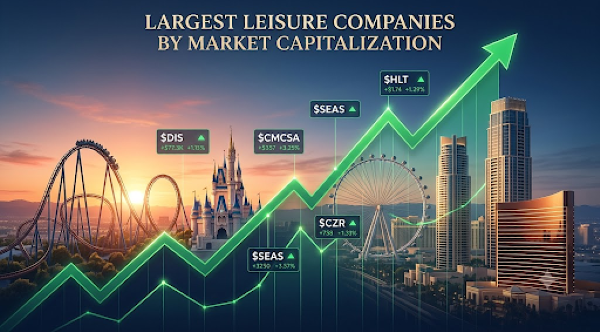
Market capitalization is one of the most fundamental ways to assess the size and investor confidence in a publicly traded company. For leisure stocks, market cap reveals which businesses have earned the trust of global investors with their scale, profitability, and long-term growth prospects. The largest leisure companies by market capitalization are titans of global consumer culture, with brands recognized in virtually every country on earth.
Why Is Walt Disney One of the Largest Leisure Companies?
Walt Disney Company consistently ranks among the largest leisure companies globally. With operations spanning theme parks, media networks, streaming, and consumer products, Disney's diversified empire generates tens of billions in annual revenue. Its theme parks alone, including Disneyland, Walt Disney World, Disneyland Paris, and properties in Asia, attract hundreds of millions of visitors annually. Disney's stock market valuation reflects not just its current earnings but the extraordinary power of its intellectual property portfolio, which includes Marvel, Star Wars, Pixar, and its own classic characters. Few entertainment companies in history have built a brand moat as wide as Disney's.
What Makes Booking Holdings a Market Leader?
Booking Holdings is the world's largest online travel company by market capitalization. Its portfolio of platforms, including Booking.com, Priceline, Kayak, and OpenTable, makes it the dominant intermediary in global travel commerce. Booking Holdings benefits from powerful network effects: more hotels and airlines on the platform attract more travelers, which in turn attracts more suppliers. This flywheel dynamic supports high margins and sustained competitive advantages. The company's operations are particularly dominant in Europe, where Booking.com commands extraordinary market share among accommodation platforms.
How Has Marriott Built the World's Largest Hotel Company?
Marriott International is the world's largest hotel company, operating and franchising more than 8,000 properties across nearly 140 countries under more than 30 brand names. Its asset-light franchise model means that Marriott earns fees for brand licensing, reservations, and loyalty program management without owning most of the physical hotels. This dramatically reduces capital intensity and allows Marriott to generate exceptional returns on equity. Its Bonvoy loyalty program has more than 190 million members, creating a massive direct marketing channel.
Why Does Hilton Continue to Grow Globally?
Hilton Worldwide Holdings follows a similar asset-light strategy and has consistently delivered impressive shareholder returns since its initial public offering. Hilton's global footprint spans luxury, upper upscale, and budget segments, allowing it to capture leisure and business travelers at every price point. Its expansion in Asia Pacific is particularly exciting as a long-term growth driver, given the rapidly growing middle class in that region.
How Do Universal Studios Strengthen Comcast's Leisure Business?
Comcast, while primarily a telecommunications and media company, owns NBCUniversal, which includes Universal Studios theme parks and one of the world's most valuable entertainment content libraries. Universal's theme parks are direct Disney competitors and have been gaining market share with attractions tied to its Harry Potter, Minions, and Fast and Furious franchises. Comcast's leisure assets are a significant contributor to its overall valuation.
Why Is Expedia a Major Player in Online Travel?
Expedia Group rounds out the major online travel agency space alongside Booking Holdings. With brands including Expedia, Hotels.com, Vrbo, and Trivago, the company serves tens of millions of travelers globally each year. Expedia has been investing heavily in technology to improve its platform experience and reduce customer acquisition costs, which should drive margin expansion over time.
Which Casino Companies Dominate the Public Markets?
MGM Resorts International, Las Vegas Sands, and Wynn Resorts represent the largest publicly traded casino and gaming operators. Las Vegas Sands, with its massive integrated resort properties in Macau and Singapore, is particularly well positioned to benefit from continued growth in Asian gaming tourism. These companies combine massive physical assets with growing digital gaming operations.
Which Cruise Companies Lead the Industry by Market Value?
Royal Caribbean Group and Carnival Corporation dominate the cruise industry by market cap. Royal Caribbean has consistently outgrown the broader cruise market through aggressive capacity additions and innovative new ship designs that attract younger travelers. Understanding these giant companies and what drives their valuations gives investors the foundation needed to make informed allocation decisions across the leisure sector.
🚀 Expand Your Edge: Elite Leisure Industry Investment Intelligence
The leisure industry spans travel, entertainment, hospitality, gaming, sports, recreation, and experiential businesses that benefit from rising consumer spending and long-term demographic trends. Our Leisure Industry Investor Intelligence Hub brings together comprehensive research covering industry fundamentals, market-leading companies, macroeconomic drivers, financial analysis, emerging technologies, and future growth opportunities. Explore the curated resources below to build a deeper understanding of one of the market's most dynamic sectors.
🌎 Industry Fundamentals & Market Leaders
🎯 Leisure Industry Sectors & Investment Opportunities
📊 Financial Analysis & Portfolio Strategy
🤖 Technology, AI & Industry Innovation
🌍 Economic Trends & Market Drivers
⚠️ Risk Management & Smart Investing