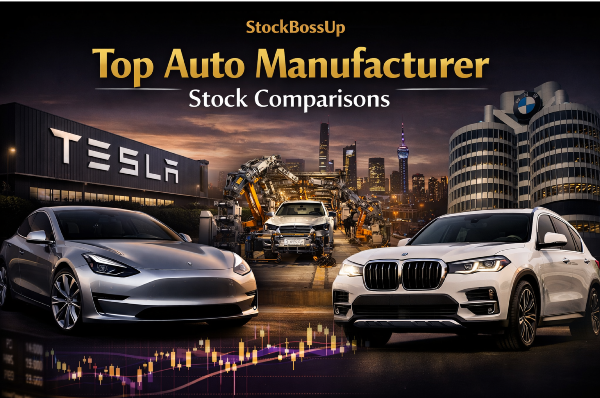
🔑 Key Takeaways: Top Auto Manufacturer Stock Comparisons
🚗 Auto stocks are not directly comparable because their business models are fundamentally different
Top auto manufacturers like Toyota Motor Corporation (TM), Ford Motor Company (F), and Tesla, Inc. (TSLA) operate under different financial structures. Some rely on stable vehicle sales and dividends, while others depend on future growth expectations and technology expansion. This makes direct comparisons misleading without context.
📈 Traditional automakers offer more stable cash flow, while EV companies offer higher growth potential
Companies like General Motors (GM) and Toyota Motor Corporation (TM) tend to generate consistent earnings from trucks, SUVs, and global production scale. EV leaders like Tesla, Inc. (TSLA) focus on rapid expansion, software integration, and battery innovation, which increases growth potential but also volatility.
⚖️ Market cycles and interest rates heavily influence auto stock performance
Auto stocks are highly cyclical. Traditional automakers often perform better during stable or high-interest environments due to consistent cash flow, while EV stocks tend to be more sensitive to interest rates, investor sentiment, and future growth expectations.
🔋 The best auto stock depends on whether investors prioritize stability or transformation
Investors choosing Toyota Motor Corporation (TM) or Ford Motor Company (F) are typically prioritizing stability, dividends, and predictable earnings. Investors choosing Tesla, Inc. (TSLA) or other EV companies are prioritizing long-term growth tied to the electric and software-driven transformation of the auto industry.
Top Auto Manufacturer Stock Comparisons: A Deep Investment Breakdown
At first glance, comparing top auto manufacturer stocks seems simple. Investors look at big names like Toyota, Ford, or Tesla and assume the strongest brand equals the best investment.
But that assumption creates a hidden problem.
Auto stocks do not behave the same way, even when companies compete in the same market. Some grow through scale. Some grow through innovation. Some pay steady dividends. Others depend heavily on future expectations.
Many investors only realize later that strong car brands do not always translate into strong stock performance.
So which auto manufacturer stocks actually compare best when you look at long-term growth, risk, and stability?
The answer depends on how each company makes money and where it is in the industry cycle.
Why Are Auto Manufacturer Stocks So Difficult to Compare?
Auto companies operate in one of the most complex industries in the world. They depend on:
- Global supply chains
- Commodity prices
- Interest rates
- Consumer demand cycles
- Technology transitions
Major global automakers include:
- Toyota Motor Corporation (TM)
- Ford Motor Company (F)
- General Motors (GM)
- Volkswagen Group (VWAGY)
- Tesla, Inc. (TSLA)
- Honda (HMC)
- Hyundai Motor Company (HYMTF)
These companies all compete in transportation, but their financial models are very different.
Some rely on high-volume sales. Others rely on innovation cycles. Some focus on trucks. Others focus on software and EV systems.
Why Do Toyota and Ford Represent Two Different Investment Styles?
Toyota Motor Corporation represents stability and long-term engineering consistency.
Ford Motor Company represents cyclical demand and truck-driven profitability.
Toyota focuses on:
- Hybrid leadership
- Global diversification
- Long product cycles
- Conservative engineering
Ford focuses on:
- Pickup truck margins
- North American demand
- Cyclical earnings
- EV transition investment
A lesser-known insight is that Toyota’s hybrid systems have allowed it to remain consistently profitable even during periods of major industry disruption.
How Do Tesla and Traditional Automakers Compare?
Tesla, Inc. operates differently from traditional automakers. It behaves more like a technology company than a manufacturing company.
Traditional automakers like GM and Volkswagen Group rely on:
- Physical vehicle sales
- Dealer networks
- Manufacturing efficiency
Tesla relies on:
- Software updates
- Future growth expectations
- Battery innovation
- Direct sales model
| Category |
Tesla (TSLA) |
Traditional Automakers |
| Revenue Model |
Growth + software |
Vehicle sales |
| Profit Stability |
Variable |
Stable |
| Volatility |
High |
Moderate |
| Growth Driver |
Technology |
Volume |
Why Do Truck-Based Automakers Matter So Much?
Ford and General Motors rely heavily on trucks and SUVs, especially in North America.
Trucks are important because they:
- Generate high profit margins
- Have long replacement cycles
- Create strong brand loyalty
- Perform well in economic expansions
One important detail is that pickup trucks often generate more profit per unit than many passenger vehicles, which helps stabilize earnings.
How Does Volkswagen Fit Into Global Auto Comparisons?
Volkswagen Group is one of the most diversified automakers in the world.
It operates:
- Volkswagen (mass-market)
- Audi (premium)
- Porsche (luxury performance)
- Commercial vehicle divisions
This diversification reduces risk but increases operational complexity.
Volkswagen is also one of the largest global EV producers, making it a key bridge between traditional and electric vehicles.
Why Are Asian Automakers Seen as Stable?
Asian automakers like Toyota, Honda, and Hyundai are often viewed as long-term stability plays.
They focus on:
- Reliability
- Conservative engineering
- Efficient manufacturing
- Gradual innovation cycles
Hyundai Motor Company has improved its reputation significantly through better quality control and longer warranties.
How Do Auto Stocks Perform Across Economic Cycles?
Auto stocks are highly cyclical because vehicle purchases depend on economic confidence.
| Economic Phase |
Strong Performers |
Weak Performers |
| Expansion |
Ford, GM, Tesla |
Defensive automakers |
| Recession |
Toyota, Honda |
High-growth EV startups |
| Recovery |
Mixed across sector |
Highly leveraged EV firms |
Auto demand often declines quickly during recessions because vehicles are large discretionary purchases.
Why Do EV Stocks Behave Like Tech Stocks?
EV companies like Tesla, Inc. behave more like technology companies than traditional automakers.
They depend on:
- Future growth expectations
- Battery innovation
- Software ecosystems
- Market expansion
This creates higher volatility compared to traditional automakers, which rely on current cash flow.
Why Do Traditional Automakers Still Lead in Sales?
Despite EV growth, traditional automakers still dominate global sales volume.
Toyota Motor Corporation remains a global leader due to:
- Hybrid leadership
- Strong global manufacturing
- Reliability reputation
Gas and hybrid vehicles still dominate in many regions due to limited EV infrastructure.
How Do Profit Models Differ Across Auto Stocks?
Auto companies generate profits in very different ways.
EV companies rely on:
- Future growth
- Technology scaling
- Battery efficiency
Traditional automakers rely on:
- Current vehicle sales
- Truck and SUV margins
- Manufacturing scale
| Factor |
EV Companies |
Traditional Automakers |
| Profit Source |
Future growth |
Current sales |
| Risk Level |
High |
Moderate |
| Cash Flow |
Developing |
Strong |
| Stability |
Low |
High |
Why Is Timing So Important in Auto Investing?
Timing is critical because the industry is in transition.
EV investors often face:
- High volatility
- Delayed profitability
- Rapid valuation changes
Traditional automakers often provide:
- Steady dividends
- Stable cash flow
- Lower volatility
Even small changes in interest rates can significantly impact auto demand because most vehicles are financed.
Why Do Some Auto Stocks Perform Better Long-Term?
Long-term success often depends on adaptability.
Companies that balance:
- Profit stability
- Technology transition
- Global diversification
tend to perform better over time.
Toyota Motor Corporation is a strong example of balancing hybrid leadership with gradual EV development.
Final Answer: Which Auto Manufacturer Stocks Are Best?
There is no single best category of auto stocks.
Tesla, Inc. represents high-growth potential with high volatility. Toyota and Ford represent stability and predictable cash flow. Volkswagen and Hyundai sit between growth and stability.
The key difference is structure, not just technology.
One group is valued on future expectations. The other is valued on current earnings.
The best choice depends on whether the goal is long-term growth exposure or stable income and predictable returns during a changing industry cycle.


















🔑 Key Takeaways: Top Auto Manufacturer Stock Comparisons
🚗 Auto stocks are not directly comparable because their business models are fundamentally different
Top auto manufacturers like Toyota Motor Corporation (TM), Ford Motor Company (F), and Tesla, Inc. (TSLA) operate under different financial structures. Some rely on stable vehicle sales and dividends, while others depend on future growth expectations and technology expansion. This makes direct comparisons misleading without context.
📈 Traditional automakers offer more stable cash flow, while EV companies offer higher growth potential
Companies like General Motors (GM) and Toyota Motor Corporation (TM) tend to generate consistent earnings from trucks, SUVs, and global production scale. EV leaders like Tesla, Inc. (TSLA) focus on rapid expansion, software integration, and battery innovation, which increases growth potential but also volatility.
⚖️ Market cycles and interest rates heavily influence auto stock performance
Auto stocks are highly cyclical. Traditional automakers often perform better during stable or high-interest environments due to consistent cash flow, while EV stocks tend to be more sensitive to interest rates, investor sentiment, and future growth expectations.
🔋 The best auto stock depends on whether investors prioritize stability or transformation
Investors choosing Toyota Motor Corporation (TM) or Ford Motor Company (F) are typically prioritizing stability, dividends, and predictable earnings. Investors choosing Tesla, Inc. (TSLA) or other EV companies are prioritizing long-term growth tied to the electric and software-driven transformation of the auto industry.
Top Auto Manufacturer Stock Comparisons: A Deep Investment Breakdown
At first glance, comparing top auto manufacturer stocks seems simple. Investors look at big names like Toyota, Ford, or Tesla and assume the strongest brand equals the best investment.
But that assumption creates a hidden problem.
Auto stocks do not behave the same way, even when companies compete in the same market. Some grow through scale. Some grow through innovation. Some pay steady dividends. Others depend heavily on future expectations.
Many investors only realize later that strong car brands do not always translate into strong stock performance.
So which auto manufacturer stocks actually compare best when you look at long-term growth, risk, and stability?
The answer depends on how each company makes money and where it is in the industry cycle.
Why Are Auto Manufacturer Stocks So Difficult to Compare?
Auto companies operate in one of the most complex industries in the world. They depend on:
Major global automakers include:
These companies all compete in transportation, but their financial models are very different.
Some rely on high-volume sales. Others rely on innovation cycles. Some focus on trucks. Others focus on software and EV systems.
Why Do Toyota and Ford Represent Two Different Investment Styles?
Toyota Motor Corporation represents stability and long-term engineering consistency.
Ford Motor Company represents cyclical demand and truck-driven profitability.
Toyota focuses on:
Ford focuses on:
A lesser-known insight is that Toyota’s hybrid systems have allowed it to remain consistently profitable even during periods of major industry disruption.
How Do Tesla and Traditional Automakers Compare?
Tesla, Inc. operates differently from traditional automakers. It behaves more like a technology company than a manufacturing company.
Traditional automakers like GM and Volkswagen Group rely on:
Tesla relies on:
Why Do Truck-Based Automakers Matter So Much?
Ford and General Motors rely heavily on trucks and SUVs, especially in North America.
Trucks are important because they:
One important detail is that pickup trucks often generate more profit per unit than many passenger vehicles, which helps stabilize earnings.
How Does Volkswagen Fit Into Global Auto Comparisons?
Volkswagen Group is one of the most diversified automakers in the world.
It operates:
This diversification reduces risk but increases operational complexity.
Volkswagen is also one of the largest global EV producers, making it a key bridge between traditional and electric vehicles.
Why Are Asian Automakers Seen as Stable?
Asian automakers like Toyota, Honda, and Hyundai are often viewed as long-term stability plays.
They focus on:
Hyundai Motor Company has improved its reputation significantly through better quality control and longer warranties.
How Do Auto Stocks Perform Across Economic Cycles?
Auto stocks are highly cyclical because vehicle purchases depend on economic confidence.
Auto demand often declines quickly during recessions because vehicles are large discretionary purchases.
Why Do EV Stocks Behave Like Tech Stocks?
EV companies like Tesla, Inc. behave more like technology companies than traditional automakers.
They depend on:
This creates higher volatility compared to traditional automakers, which rely on current cash flow.
Why Do Traditional Automakers Still Lead in Sales?
Despite EV growth, traditional automakers still dominate global sales volume.
Toyota Motor Corporation remains a global leader due to:
Gas and hybrid vehicles still dominate in many regions due to limited EV infrastructure.
How Do Profit Models Differ Across Auto Stocks?
Auto companies generate profits in very different ways.
EV companies rely on:
Traditional automakers rely on:
Why Is Timing So Important in Auto Investing?
Timing is critical because the industry is in transition.
EV investors often face:
Traditional automakers often provide:
Even small changes in interest rates can significantly impact auto demand because most vehicles are financed.
Why Do Some Auto Stocks Perform Better Long-Term?
Long-term success often depends on adaptability.
Companies that balance:
tend to perform better over time.
Toyota Motor Corporation is a strong example of balancing hybrid leadership with gradual EV development.
Final Answer: Which Auto Manufacturer Stocks Are Best?
There is no single best category of auto stocks.
Tesla, Inc. represents high-growth potential with high volatility. Toyota and Ford represent stability and predictable cash flow. Volkswagen and Hyundai sit between growth and stability.
The key difference is structure, not just technology.
One group is valued on future expectations. The other is valued on current earnings.
The best choice depends on whether the goal is long-term growth exposure or stable income and predictable returns during a changing industry cycle.