Key Takeaways: Auto Manufacturers Expanding in India
🚗 India’s growth is driven more by low-cost vehicles than premium cars
India is now one of the largest auto markets globally, but demand is still heavily concentrated in affordable cars and two-wheelers. This forces automakers to prioritize cost control, small vehicle design, and financing accessibility. Even strong global brands struggle if their pricing is too high for local expectations.
⚡ Electric vehicle growth is strongest in budget and two-wheeler categories
EV expansion in India is real but not uniform. Affordable electric cars and electric two-wheelers are seeing the fastest adoption, while passenger EVs are still limited. Local companies are leading most of this growth, while global manufacturers are still scaling slowly due to infrastructure and price barriers.
🌏 Manufacturing localization is now essential for competitiveness
Automakers are moving production into India to reduce costs and meet policy requirements. Companies like Hyundai, Toyota, and Volkswagen are increasing local assembly and sourcing. India is becoming not just a sales market, but a major global manufacturing base for vehicles and exports.
📈 No single strategy works across India’s segmented auto market
India’s auto market is divided into entry-level cars, SUVs, EVs, and two-wheelers. Each segment behaves differently, and no single approach dominates all of them. The strongest performers are companies that adapt quickly across categories and adjust pricing, features, and production strategies based on demand shifts.
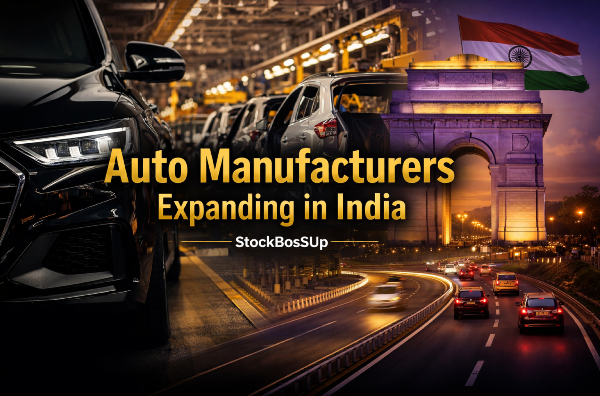
Auto Manufacturers Expanding in India
India is becoming one of the most important battlegrounds in the global auto industry. Big carmakers are pouring money into factories, electric vehicles, and supply chains. But the situation is not simple.
Some companies are growing fast. Others are struggling to adapt. A few are betting billions on the wrong strategy without realizing it yet.
The core problem is this: India is not just another car market. It is a mix of extreme price sensitivity, fast-growing cities, shifting fuel policies, and a massive two-wheeler economy that behaves very differently from Western markets.
Most automakers entering or expanding in India are chasing growth. But not all of them understand what actually drives long-term success there.
The real question is not who is investing in India.
It is who will still be winning in 10 years.
The answer is not obvious yet—and that is exactly what makes this market so important.
Why is India becoming the center of global auto expansion?
India has moved from an emerging market to a core global auto hub. Several forces are driving this shift at the same time.
Income growth is rising in urban and semi-urban regions, pushing more families toward their first car purchase. At the same time, government policy is actively encouraging local manufacturing and electric vehicle adoption.
Global automakers are also trying to reduce dependence on China, and India offers scale, labor, and improving infrastructure.
A key turning point is that India recently became the third-largest passenger vehicle market in the world, overtaking Japan. This signals a structural shift in global demand.
However, even with this growth, India remains extremely price-sensitive. Small cars still dominate, and financing conditions heavily influence demand cycles.
Which global automakers are expanding most aggressively?
Global companies are no longer treating India as a secondary market. They are building full production and sales ecosystems.
Maruti Suzuki remains the market leader, especially in small cars, but competition is intensifying across every segment.
Hyundai Motor Company is expanding aggressively in SUVs and compact vehicles.
Toyota Motor Corporation is focusing on hybrids and long-term reliability positioning.
Volkswagen Group is attempting a premium and EV-driven repositioning.
Stellantis is still building scale in India through selective model introductions.
BYD Company is cautiously expanding in EVs, focusing on niche premium segments.
Automaker Expansion Snapshot
| Company |
Strategy in India |
Key Focus |
| Maruti Suzuki |
Volume leadership |
Small cars, affordability |
| Hyundai |
Balanced growth |
SUVs + exports |
| Toyota |
Hybrid focus |
Reliability + efficiency |
| Volkswagen Group |
Premium shift |
EV + upper segment |
| Stellantis |
Market entry scaling |
Select global models |
| BYD Company |
EV niche expansion |
Premium electric cars |
How are Japanese automakers adapting to changing demand?
Japanese automakers built India’s early passenger car market, but the structure is shifting quickly.
Honda has struggled as demand moves away from sedans and toward SUVs.
Nissan is simplifying its lineup and focusing on affordability.
Suzuki continues to dominate through its partnership with Maruti Suzuki.
Toyota is one of the few Japanese firms increasing long-term investment, especially in hybrid systems.
The biggest challenge for Japanese brands is speed. India is changing faster than traditional product cycles can handle.
Why are Korean automakers gaining momentum so quickly?
Korean manufacturers have found strong success in India by balancing design, features, and pricing.
Hyundai has built strong brand trust across urban India.
Kia entered later but scaled quickly with SUV-focused models designed specifically for Indian buyers.
Their strategy works because Indian consumers often want premium features at lower price points. Korean brands are positioned directly in that gap.
What role do Indian automakers play in the market shift?
Domestic companies are not just competing—they are reshaping the industry.
Tata Motors has become a leader in affordable electric vehicles.
Mahindra & Mahindra is focusing heavily on SUVs and utility vehicles.
Bajaj Auto remains dominant in two-wheelers, which still define mobility for most Indians.
A key reality often missed is that motorcycles and scooters still outsell passenger cars by a wide margin, shaping how automakers think about entry-level demand.
Market Share Overview
| Segment |
Dominant Players |
Trend Direction |
| Entry-level cars |
Maruti Suzuki |
Stable, high volume |
| SUVs |
Hyundai, Kia, Mahindra |
Rapid growth |
| EVs |
Tata Motors |
Fast expansion |
| Two-wheelers |
Bajaj Auto |
Mass mobility dominance |
How is electric vehicle adoption changing the competition?
Electric vehicles are reshaping strategy, but adoption is uneven.
Tata Motors leads passenger EV adoption in the affordable segment.
Mahindra & Mahindra is developing electric SUVs designed for Indian road conditions.
BYD Company is targeting premium EV buyers but remains limited in scale.
India’s EV transition is currently stronger in two-wheelers and small commercial vehicles than in passenger cars.
EV Strategy Comparison
| Company |
EV Focus |
Strength |
| Tata Motors |
Affordable EVs |
Mass adoption |
| Mahindra & Mahindra |
Electric SUVs |
Utility + durability |
| BYD Company |
Premium EVs |
Technology leadership |
| Hyundai |
Gradual EV rollout |
Global integration |
What challenges slow down expansion in India?
Despite strong growth potential, India remains a difficult market.
Pricing pressure is one of the biggest challenges. Consumers expect high value at low cost, which reduces margins.
Regulatory changes can also shift quickly, especially around emissions and EV incentives.
Infrastructure limitations remain important. Charging networks, road quality, and logistics systems vary widely.
Manufacturing localization is another requirement. Companies must produce locally to compete effectively, which increases upfront investment.
How are supply chains evolving for long-term success?
Automakers are shifting from import-heavy strategies to full local production systems.
Hyundai and Maruti Suzuki already use India as a production and export base.
Toyota is expanding hybrid manufacturing partnerships.
Volkswagen Group is increasing localization to reduce costs.
This shift is not optional. It is required for survival in India’s cost-sensitive market.
Why is competition so intense across market segments?
India’s auto market is not dominated by one strategy. It is split across multiple competing layers.
Entry-level buyers prioritize affordability. Mid-range buyers want features and SUVs. Premium buyers are slowly shifting toward hybrids and EVs.
Maruti Suzuki leads entry-level volume.
Hyundai and Tata Motors compete heavily in SUVs.
Mahindra & Mahindra dominates utility-focused segments.
Toyota holds a stable hybrid premium niche.
The result is a fragmented but fast-growing market.
What is the future of auto manufacturing expansion in India?
The future of India’s auto industry will not be defined by a single dominant company. It will be shaped by multiple winners across different segments.
Affordable mobility will remain the largest volume driver. SUVs will continue growing in urban markets. EVs will gradually expand as infrastructure improves.
One major shift is already emerging. India is beginning to split into two parallel auto economies: high-volume affordability and low-volume premium electrification.
Companies that succeed will be those that adapt quickly to changing demand rather than relying on legacy strategies.
India is not a predictable market. It rewards flexibility more than scale.
The expansion race is already underway. The real challenge is not entering India.
It is staying relevant inside it.







Key Takeaways: Auto Manufacturers Expanding in India
🚗 India’s growth is driven more by low-cost vehicles than premium cars
India is now one of the largest auto markets globally, but demand is still heavily concentrated in affordable cars and two-wheelers. This forces automakers to prioritize cost control, small vehicle design, and financing accessibility. Even strong global brands struggle if their pricing is too high for local expectations.
⚡ Electric vehicle growth is strongest in budget and two-wheeler categories
EV expansion in India is real but not uniform. Affordable electric cars and electric two-wheelers are seeing the fastest adoption, while passenger EVs are still limited. Local companies are leading most of this growth, while global manufacturers are still scaling slowly due to infrastructure and price barriers.
🌏 Manufacturing localization is now essential for competitiveness
Automakers are moving production into India to reduce costs and meet policy requirements. Companies like Hyundai, Toyota, and Volkswagen are increasing local assembly and sourcing. India is becoming not just a sales market, but a major global manufacturing base for vehicles and exports.
📈 No single strategy works across India’s segmented auto market
India’s auto market is divided into entry-level cars, SUVs, EVs, and two-wheelers. Each segment behaves differently, and no single approach dominates all of them. The strongest performers are companies that adapt quickly across categories and adjust pricing, features, and production strategies based on demand shifts.
Auto Manufacturers Expanding in India
India is becoming one of the most important battlegrounds in the global auto industry. Big carmakers are pouring money into factories, electric vehicles, and supply chains. But the situation is not simple.
Some companies are growing fast. Others are struggling to adapt. A few are betting billions on the wrong strategy without realizing it yet.
The core problem is this: India is not just another car market. It is a mix of extreme price sensitivity, fast-growing cities, shifting fuel policies, and a massive two-wheeler economy that behaves very differently from Western markets.
Most automakers entering or expanding in India are chasing growth. But not all of them understand what actually drives long-term success there.
The real question is not who is investing in India.
It is who will still be winning in 10 years.
The answer is not obvious yet—and that is exactly what makes this market so important.
Why is India becoming the center of global auto expansion?
India has moved from an emerging market to a core global auto hub. Several forces are driving this shift at the same time.
Income growth is rising in urban and semi-urban regions, pushing more families toward their first car purchase. At the same time, government policy is actively encouraging local manufacturing and electric vehicle adoption.
Global automakers are also trying to reduce dependence on China, and India offers scale, labor, and improving infrastructure.
A key turning point is that India recently became the third-largest passenger vehicle market in the world, overtaking Japan. This signals a structural shift in global demand.
However, even with this growth, India remains extremely price-sensitive. Small cars still dominate, and financing conditions heavily influence demand cycles.
Which global automakers are expanding most aggressively?
Global companies are no longer treating India as a secondary market. They are building full production and sales ecosystems.
Maruti Suzuki remains the market leader, especially in small cars, but competition is intensifying across every segment.
Hyundai Motor Company is expanding aggressively in SUVs and compact vehicles.
Toyota Motor Corporation is focusing on hybrids and long-term reliability positioning.
Volkswagen Group is attempting a premium and EV-driven repositioning.
Stellantis is still building scale in India through selective model introductions.
BYD Company is cautiously expanding in EVs, focusing on niche premium segments.
Automaker Expansion Snapshot
How are Japanese automakers adapting to changing demand?
Japanese automakers built India’s early passenger car market, but the structure is shifting quickly.
Honda has struggled as demand moves away from sedans and toward SUVs.
Nissan is simplifying its lineup and focusing on affordability.
Suzuki continues to dominate through its partnership with Maruti Suzuki.
Toyota is one of the few Japanese firms increasing long-term investment, especially in hybrid systems.
The biggest challenge for Japanese brands is speed. India is changing faster than traditional product cycles can handle.
Why are Korean automakers gaining momentum so quickly?
Korean manufacturers have found strong success in India by balancing design, features, and pricing.
Hyundai has built strong brand trust across urban India.
Kia entered later but scaled quickly with SUV-focused models designed specifically for Indian buyers.
Their strategy works because Indian consumers often want premium features at lower price points. Korean brands are positioned directly in that gap.
What role do Indian automakers play in the market shift?
Domestic companies are not just competing—they are reshaping the industry.
Tata Motors has become a leader in affordable electric vehicles.
Mahindra & Mahindra is focusing heavily on SUVs and utility vehicles.
Bajaj Auto remains dominant in two-wheelers, which still define mobility for most Indians.
A key reality often missed is that motorcycles and scooters still outsell passenger cars by a wide margin, shaping how automakers think about entry-level demand.
Market Share Overview
How is electric vehicle adoption changing the competition?
Electric vehicles are reshaping strategy, but adoption is uneven.
Tata Motors leads passenger EV adoption in the affordable segment.
Mahindra & Mahindra is developing electric SUVs designed for Indian road conditions.
BYD Company is targeting premium EV buyers but remains limited in scale.
India’s EV transition is currently stronger in two-wheelers and small commercial vehicles than in passenger cars.
EV Strategy Comparison
What challenges slow down expansion in India?
Despite strong growth potential, India remains a difficult market.
Pricing pressure is one of the biggest challenges. Consumers expect high value at low cost, which reduces margins.
Regulatory changes can also shift quickly, especially around emissions and EV incentives.
Infrastructure limitations remain important. Charging networks, road quality, and logistics systems vary widely.
Manufacturing localization is another requirement. Companies must produce locally to compete effectively, which increases upfront investment.
How are supply chains evolving for long-term success?
Automakers are shifting from import-heavy strategies to full local production systems.
Hyundai and Maruti Suzuki already use India as a production and export base.
Toyota is expanding hybrid manufacturing partnerships.
Volkswagen Group is increasing localization to reduce costs.
This shift is not optional. It is required for survival in India’s cost-sensitive market.
Why is competition so intense across market segments?
India’s auto market is not dominated by one strategy. It is split across multiple competing layers.
Entry-level buyers prioritize affordability. Mid-range buyers want features and SUVs. Premium buyers are slowly shifting toward hybrids and EVs.
Maruti Suzuki leads entry-level volume.
Hyundai and Tata Motors compete heavily in SUVs.
Mahindra & Mahindra dominates utility-focused segments.
Toyota holds a stable hybrid premium niche.
The result is a fragmented but fast-growing market.
What is the future of auto manufacturing expansion in India?
The future of India’s auto industry will not be defined by a single dominant company. It will be shaped by multiple winners across different segments.
Affordable mobility will remain the largest volume driver. SUVs will continue growing in urban markets. EVs will gradually expand as infrastructure improves.
One major shift is already emerging. India is beginning to split into two parallel auto economies: high-volume affordability and low-volume premium electrification.
Companies that succeed will be those that adapt quickly to changing demand rather than relying on legacy strategies.
India is not a predictable market. It rewards flexibility more than scale.
The expansion race is already underway. The real challenge is not entering India.
It is staying relevant inside it.