Key Takeaways
🚗 U.S. auto manufacturing remains a global leader in innovation and production scale
The United States auto industry is still one of the most influential in the world, led by companies like Ford Motor Company, General Motors, and Tesla, Inc.. Its strength comes from large-scale production, strong domestic demand, and leadership in automotive technology.
⚡ Electric vehicles and software are reshaping the future of U.S. automotive manufacturing
The shift toward EVs and software-defined vehicles is transforming how cars are designed, built, and sold. Companies are investing heavily in batteries, autonomous driving systems, and digital platforms to stay competitive in a rapidly changing global market.
🌍 Global competition is increasing pressure on U.S. automakers
The U.S. auto industry now competes directly with China, Germany, and Japan across EV production, efficiency, and technology innovation. This rising competition is forcing faster development cycles and greater investment in advanced manufacturing.
⚙️ Supply chains, labor costs, and infrastructure will define future competitiveness
High labor costs, dependence on global supply chains, and uneven EV infrastructure remain key challenges. Future success will depend on reshoring production, improving battery supply chains, and increasing automation in manufacturing plants.
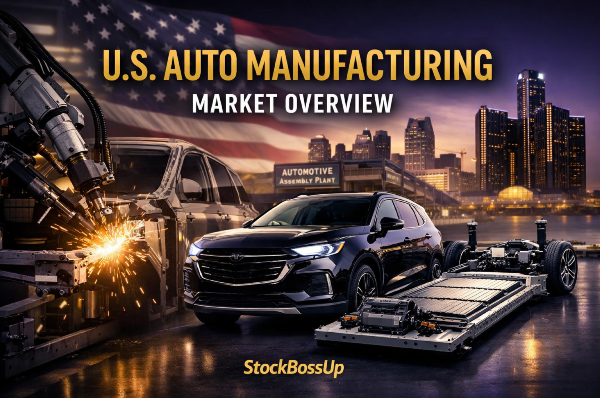
U.S. Auto Manufacturing Market Overview
The auto industry in the United States looks powerful on the surface. It has major global brands, advanced technology, and massive production capacity. The market in the United States remains one of the most important in the world.
But there is a hidden problem. The industry is changing faster than many expect. Costs are rising. Electric vehicles are reshaping production. Global competition is increasing. Many assume the U.S. will stay dominant because it always has. That assumption may not hold in the long run.
The real question is not whether the U.S. auto industry is strong today. It is whether it can stay competitive while everything around it changes.
Why Did the United States Become an Auto Manufacturing Powerhouse?
The U.S. auto industry grew quickly during the industrial boom of the 20th century.
Companies like General Motors, Ford Motor Company, and Stellantis North America built massive production systems.
The assembly line model helped the U.S. lead global car production for decades. It made cars affordable for everyday consumers.
Strong domestic demand also supported growth. A large population and expanding highway system increased vehicle ownership.
What Makes U.S. Auto Manufacturing Different?
The U.S. auto industry is built around scale and flexibility.
Manufacturers produce a wide range of vehicles, from compact cars to large trucks and SUVs. Pickup trucks are especially important in the U.S. market.
There is also a strong focus on innovation. Many new automotive technologies are developed in the U.S., especially in software and electric vehicles.
Another key difference is labor structure. Some regions have strong unions, while others operate with more flexible labor systems.
Why Are Trucks So Important in the U.S. Market?
The U.S. has a unique preference for larger vehicles.
Pickup trucks and SUVs dominate sales. This is different from many global markets that focus on smaller cars.
This shapes manufacturing decisions. Companies design entire platforms around these segments.
A key financial reality is that full-size pickup trucks often generate more profit per unit than many smaller passenger cars combined.
How Did U.S. Manufacturing Expand Globally?
The U.S. auto industry expanded beyond its borders over time.
Automakers built plants in Mexico, Canada, and other regions to reduce costs.
Mexico became a major production hub due to lower labor costs and trade agreements.
Global expansion helped companies stay competitive while maintaining design and engineering strength in the U.S.
| Factor |
U.S. Strength |
Industry Impact |
| Market Size |
Very large |
Strong domestic demand |
| Vehicle Preference |
Trucks/SUVs dominant |
High profit margins |
| Global Expansion |
Extensive |
Cost efficiency |
| Innovation |
Strong |
Technology leadership |
How Is Electric Vehicle Growth Changing the Industry?
Electric vehicles are transforming U.S. auto manufacturing.
Companies are investing heavily in EV platforms and battery production.
Tesla has played a major role in accelerating EV adoption in the U.S. and globally.
Traditional automakers are also shifting production toward electric models.
Charging infrastructure is expanding, but unevenly across regions.
Why Is the U.S. Facing Rising Global Competition?
The U.S. auto industry is no longer the only major player.
China leads in EV production and battery supply chains.
Germany remains strong in engineering and premium vehicles.
Japan continues to lead in reliability and hybrid systems.
This global competition forces U.S. companies to move faster.
What Role Does Labor Play in U.S. Manufacturing?
Labor is a major factor in U.S. auto production.
Wages are higher than in many other countries, increasing production costs.
Unionized labor plays a strong role in many factories.
At the same time, automation is growing quickly. Robots and AI systems are increasingly used in assembly plants.
This helps reduce long-term labor pressure.
Are Supply Chains a Strength or Weakness?
The U.S. has a complex supply chain system.
It relies on both domestic and international suppliers.
This creates flexibility but also risk.
Recent disruptions exposed dependence on global components, especially semiconductors.
Battery supply chains are still developing.
| Supply Chain Element |
Strength Level |
Key Benefit |
| Domestic production |
Moderate |
Stability |
| Global sourcing |
High |
Cost efficiency |
| Chip supply |
Vulnerable |
Production delays |
| EV batteries |
Developing |
Growth opportunity |
Why Is Innovation So Central to the U.S. Market?
The U.S. is a global leader in automotive innovation.
Companies are heavily investing in:
- Electric vehicles
- Autonomous driving systems
- Software-defined vehicles
- Artificial intelligence
Cars are becoming more like software platforms than mechanical machines.
How Is Government Policy Shaping the Industry?
Government policy is playing a growing role.
Incentives support EV adoption and domestic manufacturing.
Tax credits encourage battery production in the U.S.
Environmental regulations push automakers toward cleaner vehicles.
Policy direction is shaping long-term investment decisions.
What Are the Biggest Risks Facing U.S. Auto Manufacturing?
The industry faces several key risks.
High labor costs reduce global competitiveness.
Dependence on foreign supply chains creates vulnerabilities.
The EV transition requires massive capital investment.
Competition from China and Europe continues to intensify.
Infrastructure readiness for EV expansion is still uneven.
How Are U.S. Automakers Responding?
U.S. automakers are adapting quickly.
They are investing in EV production and battery plants.
They are forming partnerships with technology companies.
They are expanding manufacturing in North America to reduce supply chain risk.
Many are redesigning entire vehicle platforms for electric powertrains.
Why Do People Misunderstand the U.S. Auto Industry?
Many people assume the U.S. industry is declining.
Others assume its dominance is guaranteed because of history.
Both views miss the reality of transformation.
The industry is not shrinking. It is shifting.
The challenge is adapting fast enough to global change.
What Role Do Technology Companies Play?
Technology companies are increasingly important in the U.S. auto market.
Firms working in software, chips, and AI are shaping vehicle development.
Cars now rely heavily on software updates and digital systems.
This is creating new business models based on subscriptions and services.
| Strategy Type |
Purpose |
Outcome |
| EV investment |
Future growth |
Market transition |
| Software integration |
Vehicle intelligence |
Competitive edge |
| Domestic expansion |
Supply chain control |
Risk reduction |
| Partnerships |
Technology access |
Faster innovation |
How Fast Is the Industry Changing?
The pace of change is extremely fast.
Electric vehicle adoption is increasing every year.
Software updates are becoming standard in modern vehicles.
One key shift is that some U.S. automakers now earn more profit from trucks and SUVs than from entire global car lines combined.
Another shift is development speed. EV platforms are being developed in nearly half the time it used to take for traditional vehicles.
What Does This Mean for Global Competition?
The U.S. remains one of the most important auto manufacturing markets in the world.
It leads in technology, scale, and profit-driven vehicle segments.
However, global competition is stronger than ever.
China leads in EV production. Europe leads in regulation-driven innovation. Japan leads in hybrid efficiency.
This creates a highly competitive global environment.
Why Is Brand Power Still Strong?
U.S. automotive brands remain highly influential.
Ford, GM, and Tesla have strong global recognition.
These brands are associated with innovation, power, and scale.
Brand strength helps maintain market share during industry transitions.
Where Is the Real Opportunity?
The biggest opportunity lies in electric vehicles, software, and mobility services.
The U.S. has strong advantages in technology and innovation ecosystems.
If companies successfully integrate software and hardware, they can maintain global leadership.
Battery production and supply chain localization are also major opportunities.
So What Solves the Original Problem?
At the beginning, we asked whether the U.S. can stay competitive while the auto industry transforms.
The answer depends on adaptation speed.
The U.S. already has strong foundations in innovation, scale, and brand power.
The challenge is managing costs, supply chains, and the EV transition at the same time.
Those who understand this shift will see where the U.S. still leads. Those who do not may underestimate how quickly the global auto industry is changing.












Key Takeaways
🚗 U.S. auto manufacturing remains a global leader in innovation and production scale
The United States auto industry is still one of the most influential in the world, led by companies like Ford Motor Company, General Motors, and Tesla, Inc.. Its strength comes from large-scale production, strong domestic demand, and leadership in automotive technology.
⚡ Electric vehicles and software are reshaping the future of U.S. automotive manufacturing
The shift toward EVs and software-defined vehicles is transforming how cars are designed, built, and sold. Companies are investing heavily in batteries, autonomous driving systems, and digital platforms to stay competitive in a rapidly changing global market.
🌍 Global competition is increasing pressure on U.S. automakers
The U.S. auto industry now competes directly with China, Germany, and Japan across EV production, efficiency, and technology innovation. This rising competition is forcing faster development cycles and greater investment in advanced manufacturing.
⚙️ Supply chains, labor costs, and infrastructure will define future competitiveness
High labor costs, dependence on global supply chains, and uneven EV infrastructure remain key challenges. Future success will depend on reshoring production, improving battery supply chains, and increasing automation in manufacturing plants.
U.S. Auto Manufacturing Market Overview
The auto industry in the United States looks powerful on the surface. It has major global brands, advanced technology, and massive production capacity. The market in the United States remains one of the most important in the world.
But there is a hidden problem. The industry is changing faster than many expect. Costs are rising. Electric vehicles are reshaping production. Global competition is increasing. Many assume the U.S. will stay dominant because it always has. That assumption may not hold in the long run.
The real question is not whether the U.S. auto industry is strong today. It is whether it can stay competitive while everything around it changes.
Why Did the United States Become an Auto Manufacturing Powerhouse?
The U.S. auto industry grew quickly during the industrial boom of the 20th century.
Companies like General Motors, Ford Motor Company, and Stellantis North America built massive production systems.
The assembly line model helped the U.S. lead global car production for decades. It made cars affordable for everyday consumers.
Strong domestic demand also supported growth. A large population and expanding highway system increased vehicle ownership.
What Makes U.S. Auto Manufacturing Different?
The U.S. auto industry is built around scale and flexibility.
Manufacturers produce a wide range of vehicles, from compact cars to large trucks and SUVs. Pickup trucks are especially important in the U.S. market.
There is also a strong focus on innovation. Many new automotive technologies are developed in the U.S., especially in software and electric vehicles.
Another key difference is labor structure. Some regions have strong unions, while others operate with more flexible labor systems.
Why Are Trucks So Important in the U.S. Market?
The U.S. has a unique preference for larger vehicles.
Pickup trucks and SUVs dominate sales. This is different from many global markets that focus on smaller cars.
This shapes manufacturing decisions. Companies design entire platforms around these segments.
A key financial reality is that full-size pickup trucks often generate more profit per unit than many smaller passenger cars combined.
How Did U.S. Manufacturing Expand Globally?
The U.S. auto industry expanded beyond its borders over time.
Automakers built plants in Mexico, Canada, and other regions to reduce costs.
Mexico became a major production hub due to lower labor costs and trade agreements.
Global expansion helped companies stay competitive while maintaining design and engineering strength in the U.S.
How Is Electric Vehicle Growth Changing the Industry?
Electric vehicles are transforming U.S. auto manufacturing.
Companies are investing heavily in EV platforms and battery production.
Tesla has played a major role in accelerating EV adoption in the U.S. and globally.
Traditional automakers are also shifting production toward electric models.
Charging infrastructure is expanding, but unevenly across regions.
Why Is the U.S. Facing Rising Global Competition?
The U.S. auto industry is no longer the only major player.
China leads in EV production and battery supply chains.
Germany remains strong in engineering and premium vehicles.
Japan continues to lead in reliability and hybrid systems.
This global competition forces U.S. companies to move faster.
What Role Does Labor Play in U.S. Manufacturing?
Labor is a major factor in U.S. auto production.
Wages are higher than in many other countries, increasing production costs.
Unionized labor plays a strong role in many factories.
At the same time, automation is growing quickly. Robots and AI systems are increasingly used in assembly plants.
This helps reduce long-term labor pressure.
Are Supply Chains a Strength or Weakness?
The U.S. has a complex supply chain system.
It relies on both domestic and international suppliers.
This creates flexibility but also risk.
Recent disruptions exposed dependence on global components, especially semiconductors.
Battery supply chains are still developing.
Why Is Innovation So Central to the U.S. Market?
The U.S. is a global leader in automotive innovation.
Companies are heavily investing in:
Cars are becoming more like software platforms than mechanical machines.
How Is Government Policy Shaping the Industry?
Government policy is playing a growing role.
Incentives support EV adoption and domestic manufacturing.
Tax credits encourage battery production in the U.S.
Environmental regulations push automakers toward cleaner vehicles.
Policy direction is shaping long-term investment decisions.
What Are the Biggest Risks Facing U.S. Auto Manufacturing?
The industry faces several key risks.
High labor costs reduce global competitiveness.
Dependence on foreign supply chains creates vulnerabilities.
The EV transition requires massive capital investment.
Competition from China and Europe continues to intensify.
Infrastructure readiness for EV expansion is still uneven.
How Are U.S. Automakers Responding?
U.S. automakers are adapting quickly.
They are investing in EV production and battery plants.
They are forming partnerships with technology companies.
They are expanding manufacturing in North America to reduce supply chain risk.
Many are redesigning entire vehicle platforms for electric powertrains.
Why Do People Misunderstand the U.S. Auto Industry?
Many people assume the U.S. industry is declining.
Others assume its dominance is guaranteed because of history.
Both views miss the reality of transformation.
The industry is not shrinking. It is shifting.
The challenge is adapting fast enough to global change.
What Role Do Technology Companies Play?
Technology companies are increasingly important in the U.S. auto market.
Firms working in software, chips, and AI are shaping vehicle development.
Cars now rely heavily on software updates and digital systems.
This is creating new business models based on subscriptions and services.
How Fast Is the Industry Changing?
The pace of change is extremely fast.
Electric vehicle adoption is increasing every year.
Software updates are becoming standard in modern vehicles.
One key shift is that some U.S. automakers now earn more profit from trucks and SUVs than from entire global car lines combined.
Another shift is development speed. EV platforms are being developed in nearly half the time it used to take for traditional vehicles.
What Does This Mean for Global Competition?
The U.S. remains one of the most important auto manufacturing markets in the world.
It leads in technology, scale, and profit-driven vehicle segments.
However, global competition is stronger than ever.
China leads in EV production. Europe leads in regulation-driven innovation. Japan leads in hybrid efficiency.
This creates a highly competitive global environment.
Why Is Brand Power Still Strong?
U.S. automotive brands remain highly influential.
Ford, GM, and Tesla have strong global recognition.
These brands are associated with innovation, power, and scale.
Brand strength helps maintain market share during industry transitions.
Where Is the Real Opportunity?
The biggest opportunity lies in electric vehicles, software, and mobility services.
The U.S. has strong advantages in technology and innovation ecosystems.
If companies successfully integrate software and hardware, they can maintain global leadership.
Battery production and supply chain localization are also major opportunities.
So What Solves the Original Problem?
At the beginning, we asked whether the U.S. can stay competitive while the auto industry transforms.
The answer depends on adaptation speed.
The U.S. already has strong foundations in innovation, scale, and brand power.
The challenge is managing costs, supply chains, and the EV transition at the same time.
Those who understand this shift will see where the U.S. still leads. Those who do not may underestimate how quickly the global auto industry is changing.