🚗 Key Takeaways
🛡️ Modern auto safety relies on integrated systems, not single features
Today’s most advanced vehicles use a network of technologies like radar, cameras, AI software, and sensors working together. Features such as automatic emergency braking, lane-keeping assist, and adaptive cruise control form a connected safety ecosystem designed to reduce crashes and driver error in real time.
🤖 AI and real-time data are transforming how cars prevent accidents
Automakers are increasingly using artificial intelligence and live sensor data to predict and respond to danger faster than human reaction time. These systems continuously analyze road conditions, traffic behavior, and driver input to prevent collisions before they happen, improving overall road safety.
🚘 Leading automakers take different approaches to vehicle safety innovation
Brands like Volvo, Tesla, Mercedes-Benz, Toyota, and Subaru each focus on unique safety strategies. Some prioritize crash prevention, others emphasize software-driven automation or driver awareness systems. This creates varied driving experiences depending on how each manufacturer balances control and intervention.
⚠️ Semi-autonomous driving is advancing, but full autonomy is still limited
While modern vehicles offer highly advanced driver assistance, fully autonomous driving remains in development due to unpredictable road conditions, regulatory limits, and technical challenges. Most manufacturers are focusing on improving assisted driving systems rather than removing the driver entirely.
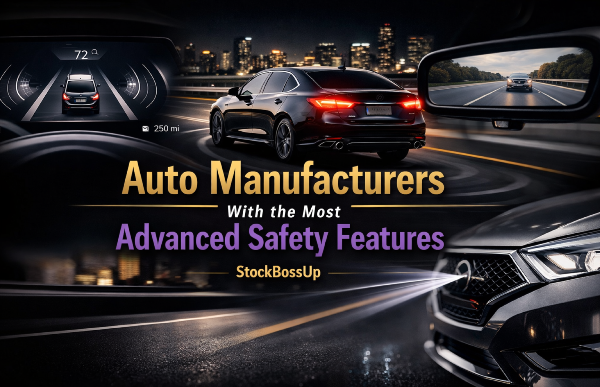
Auto Manufacturers With the Most Advanced Safety Features
Why do modern cars feel safer, yet accidents still happen?
Cars today are safer than ever. They can brake automatically, warn drivers about blind spots, and even steer themselves back into lanes. Yet accidents still happen every day on roads around the world.
This creates a confusing gap. Technology is improving quickly, but human error is still the leading cause of crashes. Drivers trust safety systems more than before, but those systems are not perfect.
The real challenge is not just building safer cars. It is making systems that can react faster than humans in unpredictable situations.
Automakers are now competing on safety technology just as much as performance or design. But the differences between brands are not always obvious to the average driver.
To understand which manufacturers are truly leading, it is important to look at how these systems actually work together in real driving conditions.
What makes a car safety system truly advanced?
Modern safety is no longer a single feature. It is a network of systems working together.
Advanced driver assistance systems combine cameras, radar, and software to detect danger before a driver can react. These systems include automatic emergency braking, lane-keeping assistance, and adaptive cruise control.
The most advanced systems can monitor the environment in multiple directions at once. They track vehicles, pedestrians, cyclists, and road signs in real time.
Some manufacturers are now moving beyond assistance and toward partial automation. This means the car can handle certain driving tasks without constant human input.
However, the real difference between brands is how smoothly these systems work together under pressure.
Why do some safety systems feel smoother than others?
Not all safety systems are equal. Some activate too late or feel overly sensitive. Others respond more naturally and quietly.
The difference often comes down to software integration. If systems are not well connected, they can react in ways that feel inconsistent to the driver.
High-end manufacturers spend years refining how sensors interpret data. This reduces false alarms and improves reaction timing.
One unexpected detail is that some systems are tuned to account for human hesitation. Instead of reacting instantly, they slightly delay certain responses to avoid unnecessary braking or steering corrections.
This makes the driving experience feel more natural while still maintaining safety.
Which automakers are leading in advanced safety technology?
Several manufacturers stand out for their safety innovation. Each takes a different approach.
Volvo is known for its long-standing focus on crash prevention and protection. Tesla relies heavily on camera-based systems and software updates. Mercedes-Benz integrates luxury with advanced driver assistance features.
Toyota focuses on widespread safety adoption across affordable vehicles. Subaru emphasizes driver awareness through its EyeSight system. BMW and Audi focus on combining performance with intelligent assistance systems.
Each brand has strengths, but their strategies differ in how much control is given to the driver versus the system.
| Manufacturer |
Safety System |
Core Technology |
Strength |
| Volvo |
Pilot Assist |
Radar + camera fusion |
Crash prevention focus |
| Tesla |
Autopilot / FSD |
Vision-based AI |
Software-driven updates |
| Mercedes-Benz |
Drive Pilot |
Multi-sensor fusion |
Comfort + safety balance |
| Toyota |
Safety Sense |
Radar + camera suite |
Wide accessibility |
| Subaru |
EyeSight |
Stereo camera system |
Driver awareness accuracy |
| BMW |
Driving Assistant |
Sensor fusion AI |
Performance integration |
How do collision prevention systems actually work?
Collision prevention systems rely on constant scanning of the road ahead. Cameras detect objects, while radar measures distance and speed.
When a potential crash is detected, the system first alerts the driver. If the driver does not respond, the car can apply braking automatically.
Some systems can even prepare the vehicle before impact. This includes tightening seatbelts, closing windows, and adjusting brake pressure.
These systems are designed to reduce reaction time to fractions of a second.
A key limitation is that they depend heavily on visibility and sensor clarity. Heavy rain, snow, or blocked cameras can reduce performance.
Why lane-keeping systems are more complex than they seem
Lane-keeping assistance may seem simple, but it involves continuous tracking of road markings.
The system must understand whether a lane shift is intentional or accidental. It does this by analyzing steering input, speed, and road curvature.
If the driver drifts unintentionally, the system gently corrects steering. If the driver signals or turns deliberately, it does nothing.
Some manufacturers tune this behavior differently. This is why certain cars feel more “helpful” while others feel more “alert.”
A subtle improvement in newer systems is smoother steering correction, which reduces the feeling of the car fighting the driver.
How adaptive cruise control reduces driver fatigue
Adaptive cruise control maintains a safe distance from the car ahead. It automatically adjusts speed based on traffic flow.
This system uses radar to measure distance and speed in real time. It can slow down in traffic and speed up when the road clears.
Unlike traditional cruise control, it works in stop-and-go traffic as well.
One interesting detail is that some advanced systems can predict traffic slowdowns based on multiple vehicles ahead, not just the car directly in front.
This reduces sudden braking and creates smoother driving in congested areas.
| Safety Feature |
Function |
Key Benefit |
Common Use |
| Automatic Emergency Braking |
Stops car before collision |
Crash reduction |
City driving |
| Lane Keeping Assist |
Keeps car centered |
Drift prevention |
Highway driving |
| Adaptive Cruise Control |
Maintains safe distance |
Reduced fatigue |
Long trips |
| Blind Spot Monitoring |
Detects hidden vehicles |
Safer lane changes |
Highway merging |
| Driver Attention Monitoring |
Detects fatigue |
Accident prevention |
Extended driving |
Why Tesla changed the safety conversation
Tesla shifted safety systems from hardware-first to software-first design.
Instead of relying heavily on radar and sensors alone, Tesla uses camera-based systems supported by machine learning.
This allows vehicles to improve over time through software updates.
The system learns from millions of miles of driving data collected from real-world usage.
One surprising development is that Tesla’s system can now recognize certain road hazards that were not explicitly programmed into the system, based on pattern recognition across its global fleet.
However, this approach also depends heavily on camera visibility and clean sensor input.
How Volvo became a leader in crash prevention
Volvo has built its reputation around safety for decades. Its systems focus heavily on preventing crashes before they happen.
The brand uses multiple layers of radar and camera systems to detect potential danger early.
Volvo also integrates safety features across all models, not just luxury vehicles.
The company has a long-term goal of reducing serious injuries and fatalities in its vehicles to extremely low levels.
Its systems often prioritize caution, even if it means slightly slower response times compared to more aggressive systems.
Why driver monitoring systems are becoming essential
Modern safety systems are not just focused on the road. They also monitor the driver.
Driver attention systems use infrared sensors and cameras to track eye movement and head position.
If the system detects signs of fatigue or distraction, it issues warnings.
Some vehicles can even slow down or stop safely if the driver becomes unresponsive.
This adds an extra layer of protection in situations where human attention drops unexpectedly.
How safety systems behave differently across brands
Each manufacturer tunes its safety systems differently. Some prioritize comfort, while others prioritize strict intervention.
For example, European brands often allow more driver control before intervening. Japanese brands tend to focus on smooth and predictable assistance. American brands vary widely depending on the company.
These differences affect how drivers perceive safety. A system that feels too aggressive may be turned off, while a smoother system is more likely to be used consistently.
Balancing intervention and comfort is one of the biggest challenges in modern automotive safety design.
Why full autonomy is still not here yet
Many cars offer semi-autonomous features, but full self-driving capability is still limited.
The main challenge is unpredictability. Roads include complex human behavior, weather conditions, and unexpected obstacles.
Even the most advanced systems struggle with rare or unusual situations.
Another issue is legal and regulatory approval. Different regions have different safety requirements and laws.
As a result, most manufacturers are focusing on assisted driving rather than full autonomy.
What the future of automotive safety will look like
The future of safety technology will be more predictive rather than reactive.
Instead of responding to danger, cars will increasingly anticipate it before it happens.
This will involve deeper integration of AI, real-time mapping, and vehicle-to-vehicle communication.
Cars may eventually share information about road conditions, hazards, and traffic patterns instantly.
One unexpected direction is that future safety systems may reduce the need for traditional driving reactions entirely in controlled environments like highways.
How advanced safety systems are changing driving forever
Modern safety systems are reshaping how people drive. They reduce stress, improve awareness, and prevent many common accidents.
However, they also change driver behavior. Some drivers become overly reliant on technology, while others stay highly engaged.
The most effective systems are those that support the driver without replacing judgment entirely.
Automakers continue to refine this balance between automation and control.
The future of automotive safety is not about removing the driver, but about creating systems that make human driving more capable, more aware, and more protected than ever before.


🚗 Key Takeaways
🛡️ Modern auto safety relies on integrated systems, not single features
Today’s most advanced vehicles use a network of technologies like radar, cameras, AI software, and sensors working together. Features such as automatic emergency braking, lane-keeping assist, and adaptive cruise control form a connected safety ecosystem designed to reduce crashes and driver error in real time.
🤖 AI and real-time data are transforming how cars prevent accidents
Automakers are increasingly using artificial intelligence and live sensor data to predict and respond to danger faster than human reaction time. These systems continuously analyze road conditions, traffic behavior, and driver input to prevent collisions before they happen, improving overall road safety.
🚘 Leading automakers take different approaches to vehicle safety innovation
Brands like Volvo, Tesla, Mercedes-Benz, Toyota, and Subaru each focus on unique safety strategies. Some prioritize crash prevention, others emphasize software-driven automation or driver awareness systems. This creates varied driving experiences depending on how each manufacturer balances control and intervention.
⚠️ Semi-autonomous driving is advancing, but full autonomy is still limited
While modern vehicles offer highly advanced driver assistance, fully autonomous driving remains in development due to unpredictable road conditions, regulatory limits, and technical challenges. Most manufacturers are focusing on improving assisted driving systems rather than removing the driver entirely.
Auto Manufacturers With the Most Advanced Safety Features
Why do modern cars feel safer, yet accidents still happen?
Cars today are safer than ever. They can brake automatically, warn drivers about blind spots, and even steer themselves back into lanes. Yet accidents still happen every day on roads around the world.
This creates a confusing gap. Technology is improving quickly, but human error is still the leading cause of crashes. Drivers trust safety systems more than before, but those systems are not perfect.
The real challenge is not just building safer cars. It is making systems that can react faster than humans in unpredictable situations.
Automakers are now competing on safety technology just as much as performance or design. But the differences between brands are not always obvious to the average driver.
To understand which manufacturers are truly leading, it is important to look at how these systems actually work together in real driving conditions.
What makes a car safety system truly advanced?
Modern safety is no longer a single feature. It is a network of systems working together.
Advanced driver assistance systems combine cameras, radar, and software to detect danger before a driver can react. These systems include automatic emergency braking, lane-keeping assistance, and adaptive cruise control.
The most advanced systems can monitor the environment in multiple directions at once. They track vehicles, pedestrians, cyclists, and road signs in real time.
Some manufacturers are now moving beyond assistance and toward partial automation. This means the car can handle certain driving tasks without constant human input.
However, the real difference between brands is how smoothly these systems work together under pressure.
Why do some safety systems feel smoother than others?
Not all safety systems are equal. Some activate too late or feel overly sensitive. Others respond more naturally and quietly.
The difference often comes down to software integration. If systems are not well connected, they can react in ways that feel inconsistent to the driver.
High-end manufacturers spend years refining how sensors interpret data. This reduces false alarms and improves reaction timing.
One unexpected detail is that some systems are tuned to account for human hesitation. Instead of reacting instantly, they slightly delay certain responses to avoid unnecessary braking or steering corrections.
This makes the driving experience feel more natural while still maintaining safety.
Which automakers are leading in advanced safety technology?
Several manufacturers stand out for their safety innovation. Each takes a different approach.
Volvo is known for its long-standing focus on crash prevention and protection. Tesla relies heavily on camera-based systems and software updates. Mercedes-Benz integrates luxury with advanced driver assistance features.
Toyota focuses on widespread safety adoption across affordable vehicles. Subaru emphasizes driver awareness through its EyeSight system. BMW and Audi focus on combining performance with intelligent assistance systems.
Each brand has strengths, but their strategies differ in how much control is given to the driver versus the system.
How do collision prevention systems actually work?
Collision prevention systems rely on constant scanning of the road ahead. Cameras detect objects, while radar measures distance and speed.
When a potential crash is detected, the system first alerts the driver. If the driver does not respond, the car can apply braking automatically.
Some systems can even prepare the vehicle before impact. This includes tightening seatbelts, closing windows, and adjusting brake pressure.
These systems are designed to reduce reaction time to fractions of a second.
A key limitation is that they depend heavily on visibility and sensor clarity. Heavy rain, snow, or blocked cameras can reduce performance.
Why lane-keeping systems are more complex than they seem
Lane-keeping assistance may seem simple, but it involves continuous tracking of road markings.
The system must understand whether a lane shift is intentional or accidental. It does this by analyzing steering input, speed, and road curvature.
If the driver drifts unintentionally, the system gently corrects steering. If the driver signals or turns deliberately, it does nothing.
Some manufacturers tune this behavior differently. This is why certain cars feel more “helpful” while others feel more “alert.”
A subtle improvement in newer systems is smoother steering correction, which reduces the feeling of the car fighting the driver.
How adaptive cruise control reduces driver fatigue
Adaptive cruise control maintains a safe distance from the car ahead. It automatically adjusts speed based on traffic flow.
This system uses radar to measure distance and speed in real time. It can slow down in traffic and speed up when the road clears.
Unlike traditional cruise control, it works in stop-and-go traffic as well.
One interesting detail is that some advanced systems can predict traffic slowdowns based on multiple vehicles ahead, not just the car directly in front.
This reduces sudden braking and creates smoother driving in congested areas.
Why Tesla changed the safety conversation
Tesla shifted safety systems from hardware-first to software-first design.
Instead of relying heavily on radar and sensors alone, Tesla uses camera-based systems supported by machine learning.
This allows vehicles to improve over time through software updates.
The system learns from millions of miles of driving data collected from real-world usage.
One surprising development is that Tesla’s system can now recognize certain road hazards that were not explicitly programmed into the system, based on pattern recognition across its global fleet.
However, this approach also depends heavily on camera visibility and clean sensor input.
How Volvo became a leader in crash prevention
Volvo has built its reputation around safety for decades. Its systems focus heavily on preventing crashes before they happen.
The brand uses multiple layers of radar and camera systems to detect potential danger early.
Volvo also integrates safety features across all models, not just luxury vehicles.
The company has a long-term goal of reducing serious injuries and fatalities in its vehicles to extremely low levels.
Its systems often prioritize caution, even if it means slightly slower response times compared to more aggressive systems.
Why driver monitoring systems are becoming essential
Modern safety systems are not just focused on the road. They also monitor the driver.
Driver attention systems use infrared sensors and cameras to track eye movement and head position.
If the system detects signs of fatigue or distraction, it issues warnings.
Some vehicles can even slow down or stop safely if the driver becomes unresponsive.
This adds an extra layer of protection in situations where human attention drops unexpectedly.
How safety systems behave differently across brands
Each manufacturer tunes its safety systems differently. Some prioritize comfort, while others prioritize strict intervention.
For example, European brands often allow more driver control before intervening. Japanese brands tend to focus on smooth and predictable assistance. American brands vary widely depending on the company.
These differences affect how drivers perceive safety. A system that feels too aggressive may be turned off, while a smoother system is more likely to be used consistently.
Balancing intervention and comfort is one of the biggest challenges in modern automotive safety design.
Why full autonomy is still not here yet
Many cars offer semi-autonomous features, but full self-driving capability is still limited.
The main challenge is unpredictability. Roads include complex human behavior, weather conditions, and unexpected obstacles.
Even the most advanced systems struggle with rare or unusual situations.
Another issue is legal and regulatory approval. Different regions have different safety requirements and laws.
As a result, most manufacturers are focusing on assisted driving rather than full autonomy.
What the future of automotive safety will look like
The future of safety technology will be more predictive rather than reactive.
Instead of responding to danger, cars will increasingly anticipate it before it happens.
This will involve deeper integration of AI, real-time mapping, and vehicle-to-vehicle communication.
Cars may eventually share information about road conditions, hazards, and traffic patterns instantly.
One unexpected direction is that future safety systems may reduce the need for traditional driving reactions entirely in controlled environments like highways.
How advanced safety systems are changing driving forever
Modern safety systems are reshaping how people drive. They reduce stress, improve awareness, and prevent many common accidents.
However, they also change driver behavior. Some drivers become overly reliant on technology, while others stay highly engaged.
The most effective systems are those that support the driver without replacing judgment entirely.
Automakers continue to refine this balance between automation and control.
The future of automotive safety is not about removing the driver, but about creating systems that make human driving more capable, more aware, and more protected than ever before.